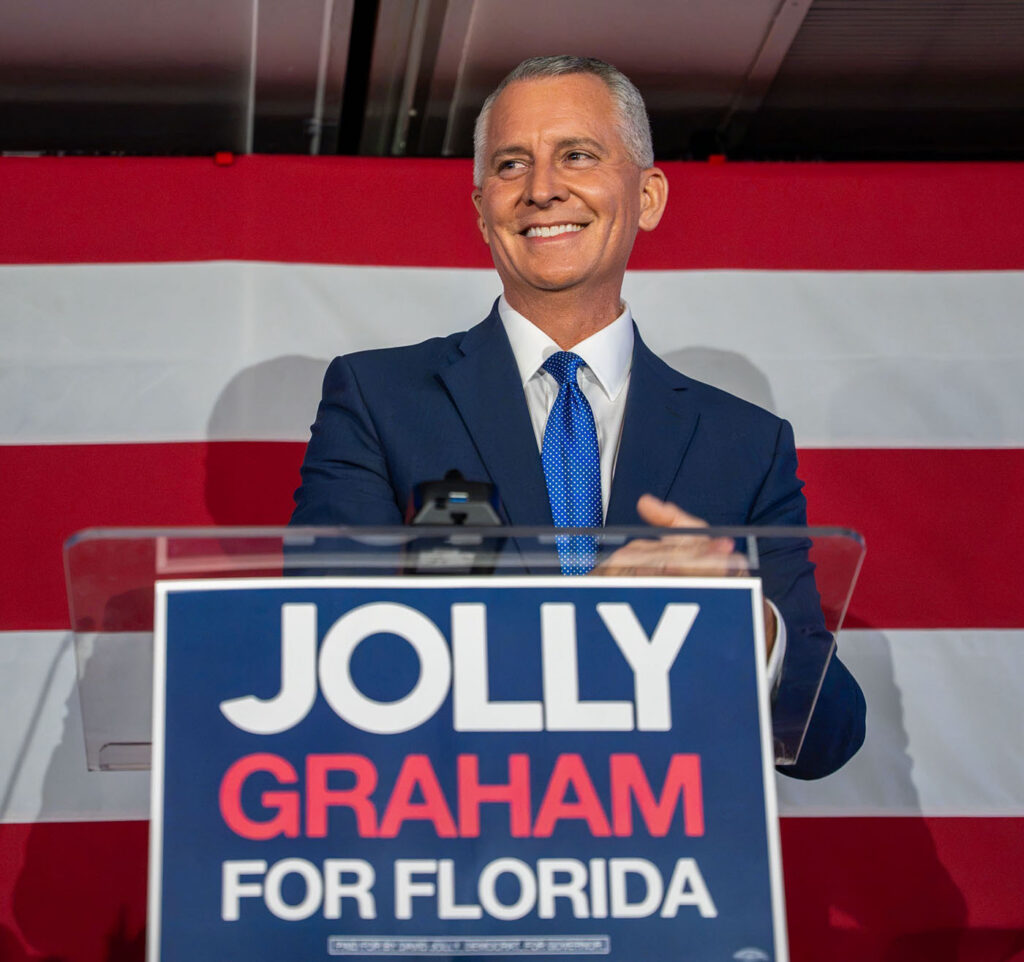

Democratic gubernatorial candidate David Jolly discusses diversity, equity and inclusion, immigration, affordable housing and his political evolution from Republican to Democrat.
As Florida approaches the November 2026 general election, M•I•A MEDIA GROUP-Legacy Editorial is examining the policies and priorities of candidates seeking to lead the state, with particular attention to issues affecting Black communities throughout Miami-Dade, Broward and Palm Beach counties.
In this exclusive interview, David Jolly, a former Republican congressman who is now the Democratic candidate for governor, addresses four significant issues: diversity, equity and inclusion; immigration and Temporary Protected Status; affordable housing and the rising cost of living; and his decision to leave the Republican Party.
Jolly outlines his vision for Florida and explains how his administration would approach policies affecting economic opportunity, racial equity and the future of the state’s Black communities.
The following questions and responses have been edited for grammar, punctuation and clarity.
1. Diversity, Equity and Inclusion (DEI)
M•I•A MEDIA GROUP: Mr. Jolly, what is your position on diversity, equity and inclusion initiatives?
Florida has eliminated or restricted DEI programs in several public institutions. Many Black professionals argue that these initiatives helped address longstanding barriers to employment, education and advancement.
Do you believe systemic racial discrimination still exists in Florida? If so, what specific policies would your administration implement to ensure Black Floridians have equal access to opportunities?
Would you restore DEI programs eliminated under Gov. Ron DeSantis, and how would you respond to opponents who argue that such initiatives constitute preferential treatment?
Jolly: Yes, I believe systemic racial discrimination still exists in Florida. As a fifth-generation Floridian, I have personally witnessed the divergent experiences between myself and people with perceived differences.
To be clear, I firmly support diversity, equity and inclusion policies because they benefit us all.
The current administration weaponized DEI to breed mistrust and distract our people from destructive policies. DEI restrictions will have no place in my administration because they are meant to harm, not help, Floridians foster economic growth.
Our Florida history is long and complex. The laws put in place to provide an equal playing field for African Americans, which ultimately benefited women, people with disabilities and the LGBTQIA+ community, created a starting foundation for basic equity. Our leaders know this.
The Jolly-Graham administration will lead with qualified subject matter experts who have lived experience, however they present.
Our administration will restore business opportunities and economic pathways for all people and modernize policies that promote advancement and entrepreneurship.
The goal is to build a stronger economy for all Floridians, focusing on work, wages and wealth by promoting inclusivity, job access, investment in workforce training and fair pay.
We will hold our public and private entities accountable through the Office of Civil Rights (OCR).
Through the OCR, our administration will encourage an inclusive ecosystem across the state.
The OCR will prioritize underserved and minority populations and diversity at all levels.
Our administration will not marginalize the people of Florida. Instead, we will build upon the values we all share: a better economy for all of us, a government that helps rather than hinders, and a state where everyone is welcome.
The OCR will act as a liaison across state offices and agencies and coordinate efforts to streamline policy, reduce administrative obstacles and address challenges and concerns for the benefit of Floridians.
Regarding the argument that these initiatives constitute preferential treatment, I simply disagree with the premise.
DEI policies created balance and allowed everyone to have a chance to be heard. A policy does not stop other people with historical advantages from remaining at the table.
We will utilize the OCR to restore DEI programs and/or challenge the legality of removing DEI programs under the previous administration.
2. Immigration and Temporary Protected Status (TPS)
M•I•A MEDIA GROUP: South Florida has one of the largest Haitian communities in the United States. What is your position on Temporary Protected Status for Haitian immigrants?
Thousands of Haitian immigrants contribute to Florida’s economy, particularly in health care, hospitality and construction. Given the ongoing instability and violence in Haiti, would you support extending their protections?
As governor, what actions would you take to protect immigrant families from unnecessary separation while respecting federal immigration laws?
What would you say to Haitian families who fear deportation, and how would your administration work with Washington to address their concerns?
Jolly: I would support extending protections to the Haitian community.
A couple of months ago, I wrote an opinion editorial on the tragic TPS policies affecting our state.
The truth is, beyond the cruelty of the policy, its impact is that it put thousands of caregivers — registered and licensed professional nurses and home health care aides — out of work and placed a tremendous burden on our seniors.
In a state where a large portion of the population is over 60 years old, the policy is not sound.
I agree that Haitian immigrants contribute to Florida’s economy, particularly in health care, hospitality and construction. We will suffer without their contributions.
Florida is better because of the depth of support they provide to us.
We do not have to engage in inhumane immigration policies. I will use the full breadth of state power to push back against immoral policies.
The goal of immigration is not to punish. Rather, the goal is to ensure that people seeking citizenship understand the appropriate pathway to living and contributing to our country.
The Jolly-Graham administration would provide counselors, therapists and social workers to oversee intake policies in our state.
While we cannot overstep federal law, we can eliminate challenges.
We value the Haitian community and will fight to sustain their families.
While I may firmly disagree with the policies of this administration, I will work with any leader willing to stop these devastating deportation policies and deter future harmful practices.
3. Affordable Housing and the Rising Cost of Living
M•I•A MEDIA GROUP: South Florida has become increasingly unaffordable for working families, particularly in historically Black communities. What would you do differently as governor?
Many longtime residents of Liberty City, Overtown, Miami Gardens, Fort Lauderdale and West Palm Beach are struggling with rising rents, property insurance premiums and housing costs.
Beyond tax relief, what specific policies would you implement to increase affordable housing, protect longtime homeowners and prevent displacement through gentrification?
How would you ensure that working-class families can continue living in the communities they helped build?
Jolly: Many longtime residents of Liberty City, Overtown, Miami Gardens, Fort Lauderdale and West Palm Beach are struggling with rising rents, property insurance premiums and housing costs.
Our state has attracted billionaires from around the world because of the beauty and economic opportunities Florida offers.
I believe they now realize that we all need a thriving community to survive market upheavals.
Instead of gutting historic communities and creating more generational wealth gaps, our administration will focus on preserving Black communities by encouraging historic designations and creating economic workforce pipelines through our 28 state colleges and universities.
These institutions work closely with our communities, understand the industries surrounding them and prepare students for jobs and careers.
We will also work with the tourism and hospitality, health care, space, sports and technology industries to identify employment gaps and connect job seekers with private, public and nonprofit organizations.
The Jolly-Graham administration will elevate existing opportunities available to fiscally constrained communities, encourage responsible development, upgrade infrastructure and provide transportation and education options that allow families to calculate costs as their households grow.
We need to educate people about the process of applying for a home loan, purchasing a home and maintaining a home with adequate financial reserves.
This is a long-term goal, but one that is necessary as more than 500 new residents move to our state daily.
To support affordable housing, we must allow for greater density on smaller lots, review zoning opportunities for businesses and utilize laws such as YIGBY — Yes in God’s Backyard — that permit housing development on property owned by faith-based institutions that welcome such projects.
We also need to work with existing nonprofits that provide support for new homeowners.
Our administration will encourage lenders to invest in communities instead of tearing them apart.
We do not want to discourage development, but we need to manage growth expectations.
When we give people an opportunity to save and invest in their homes, we reduce massive gentrification and geographic displacement.
This also means we need to incentivize lenders, homeowners and industries to invest in resilience measures for homes that are more vulnerable to natural disasters.
When you provide quality housing, health care and educational opportunities in neighborhoods and encourage workforce development, you ensure that working-class families can live in the communities they serve.
4. Your Political Evolution From Republican to Democrat
M•I•A MEDIA GROUP: Mr. Jolly, you previously served in Congress as a Republican before leaving the party and eventually becoming a Democrat. What specifically changed your political philosophy, particularly regarding issues affecting Black Americans?
During your years as a Republican, you were associated with a party whose positions on voting rights, economic opportunity, health care and racial equity have faced criticism from Black voters.
Looking back, are there policies you previously supported that you now believe negatively affected Black communities?
What would you say to voters who question whether your political transformation represents a genuine change in your convictions rather than a political calculation?
Most importantly, what evidence can you offer Black Floridians that your current positions will translate into meaningful action if you become governor?
Jolly: During the rise of the Trump administration, I realized that I no longer shared the same values as my Republican colleagues.
I was a Bush Republican and believed in strong economic principles and small government, but I never believed in cruel practices.
I saw my party crumble with the rise of the Tea Party and subsequent iterations, and I realized I simply could not follow my personal faith while witnessing atrocities against Black people.
I did not fully understand the nuances of health care disparities and maternal health challenges.
My faith teaches me to evolve, and I have.
It was not a difficult choice to move to nonparty-affiliated status because I had time to reflect on how I would continue to serve and align my leadership with my ideology.
I transitioned to the Democratic Party along with other disenfranchised Republicans who understood that we need to help, not harm.
We can be both fiscally sound and people-centered.
That is why I evolved. No regrets.
For the past two years, I have spent time in each of our 67 counties listening to Floridians’ concerns.
I left my party because it was no longer serving people.
The lack of trust, infused hate and us-against-them mentality are not part of the value system I subscribe to.
I am a proud Democrat and a servant leader.
I hope my history demonstrates my willingness to lead with the historical principles of the Democratic Party.
Regarding my future leadership, I would ask voters to look at my campaign, as I have surrounded myself with Black leaders who understand the nuances of policy and the impact on Black communities.
These leaders will continue to advise and support me and, in many cases, become part of my administration.
Most importantly, I truly believe that when we address issues affecting the Black community, we address issues affecting all communities.
When we work on issues related to Black maternal health, we support all women.
When we fight for educational equity and dignity, we support all future leaders.
When we address disparities and targeted cruelty, we make things better for other minorities.
I expect you will hold me accountable, and I am a man of my word.
