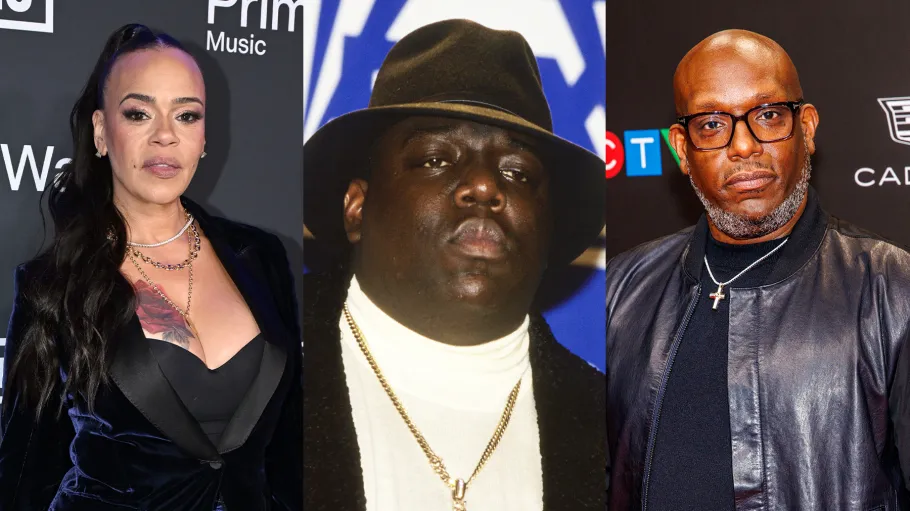






A Delaware court ruling involving the late rapper’s intellectual property raises new questions about family wealth, music ownership and who controls the financial legacy of one of hip-hop’s greatest artists.
By Maria Williamson | M•I•A MEDIA GROUP
NEW YORK — Nearly three decades after the murder of Christopher Wallace, better known as the Notorious B.I.G., a multimillion-dollar legal dispute involving his widow, singer Faith Evans, has brought renewed attention to the financial legacy of one of hip-hop’s most influential artists.
A Delaware judge has ruled that Evans must pay more than $12.5 million from the late rapper’s estate to a trust established by his mother, Voletta Wallace, following a prolonged dispute over control of his intellectual property.
The ruling marks a significant development in the battle surrounding the ownership and financial management of Biggie’s musical legacy, which continues to generate commercial interest decades after his death.
For Evans, who married Wallace in 1994 and remained his legal wife when he was killed in 1997, the decision represents a major financial and legal setback in a dispute involving the rapper’s estate.
The case also highlights a larger issue confronting the families of deceased entertainers: determining who controls valuable intellectual property and how the wealth generated by an artist’s work should be distributed across generations.
A Musical Legacy Worth Millions
The Notorious B.I.G. remains one of the most celebrated figures in hip-hop history.
His 1994 debut album, Ready to Die, introduced a distinctive storytelling style that helped redefine East Coast rap. His second album, Life After Death, was released shortly after his murder and further established his place among the genre’s greatest artists.
Songs including “Juicy,” “Big Poppa,” “Hypnotize” and “Mo Money Mo Problems” remain fixtures in popular culture.
Although Wallace was only 24 when he was killed in a drive-by shooting in Los Angeles on March 9, 1997, his music continues to reach new generations through streaming platforms, licensing agreements, documentaries and other entertainment ventures.
That enduring popularity has made the management of his intellectual property particularly important. Music copyrights, licensing arrangements, trademarks and other commercial rights can generate substantial revenue long after an artist’s death.
The Delaware dispute illustrates how those assets can become the subject of complicated legal disagreements involving family members, trusts and estate administrators.
Voletta Wallace’s Role in Protecting Her Son’s Legacy
For years, Voletta Wallace played a central role in preserving and promoting her son’s artistic legacy.
Following his death, she became one of the most recognizable guardians of his memory, participating in projects intended to introduce his music and personal story to new audiences.
Her efforts helped ensure that Biggie’s influence extended beyond the era in which he recorded. Wallace died in February 2025 at age 78, leaving behind a legacy closely connected to the preservation of her son’s achievements.
The trust established in her name is now at the center of the financial dispute.
The reported ruling directs more than $12.5 million from the rapper’s estate to that trust, although the precise allocation of assets and the court’s reasoning would require examination of the written judgment.
Faith Evans and a Complicated Family History
Evans, a Grammy-winning singer and former Bad Boy Records artist, has remained closely associated with Biggie’s legacy since their marriage.
Their relationship unfolded during one of hip-hop’s most turbulent periods, when tensions between East Coast and West Coast artists dominated headlines. Following Wallace’s death, Evans joined Sean “Puff Daddy” Combs and the group 112 on “I’ll Be Missing You,” the 1997 tribute that became an international hit.
The song helped cement Evans’ connection to her late husband’s musical legacy while introducing his story to audiences beyond traditional hip-hop listeners. Over the years, Evans has continued recording and performing, building a career that includes multiple successful albums and collaborations.
The latest court ruling places renewed scrutiny on the financial arrangements surrounding her late husband’s estate. However, the reported decision should not be interpreted as establishing personal misconduct beyond the specific findings of the court.
A Larger Question About Black Wealth and Music Ownership
Beyond the celebrity names and multimillion-dollar judgment, the dispute raises important questions about wealth preservation in the entertainment industry.
For generations, Black musicians have helped create enormously profitable music catalogs, yet disputes over ownership, contracts and estate management have sometimes complicated their families’ ability to benefit from that success.
The growing commercial value of music publishing and recording rights has made estate planning increasingly important for entertainers.
Clear agreements concerning ownership, licensing authority, trusts and inheritance can help protect artists’ financial interests and reduce conflicts among surviving family members.
Biggie’s legacy demonstrates the extraordinary earning potential of influential music catalogs. It also illustrates how complicated the administration of those assets can become when multiple parties have financial interests in the same body of work.
The Music Lives On as the Legal Battle Continues
The Notorious B.I.G.’s cultural influence remains firmly established. His storytelling, lyrical precision and unmistakable delivery helped transform hip-hop into a dominant force in American popular culture. His music continues to influence contemporary artists, while his image and recordings remain commercially valuable.
The Delaware ruling represents another chapter in the complicated history surrounding his estate, but it does not diminish his artistic achievements.
For Evans and the trust established by Voletta Wallace, the immediate questions concern financial obligations, ownership rights and the future administration of valuable intellectual property.
For fans, the dispute serves as a reminder that the business of music can remain complicated long after an artist’s final recording.
Nearly 30 years after his death, the Notorious B.I.G. continues to generate wealth, influence culture and command worldwide attention. The unresolved question is not whether his legacy has value, but how that value should be protected and distributed among those legally entitled to it.
Biggie famously rapped about the relationship between money and problems. Decades later, the legal battle surrounding his estate offers another reminder of how complicated that relationship can become.
