





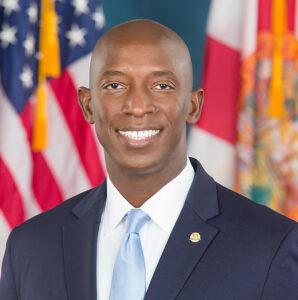

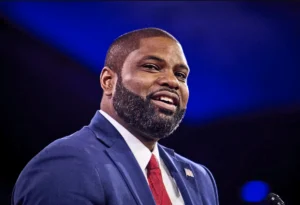
Former Miami Gardens mayor and Miami-Dade commissioner defeats Republican Te Mayonna Brown, succeeding longtime U.S. Rep. Frederica Wilson and promising to fight for affordability, economic opportunity and underserved communities.
By Marcus Ellington | M•I•A MEDIA GROUP
MIAMI GARDENS, Fla. — Oliver G. Gilbert III, the former Miami Gardens mayor whose political career has been defined by local government leadership, won Florida’s 24th Congressional District on Tuesday, securing a decisive victory that will send him to Washington as one of South Florida’s newest voices in Congress.
Gilbert, a Democrat and Miami-Dade County commissioner, defeated Republican Te Mayonna Brown in the Nov. 3 general election. CBS News projected Gilbert the winner Tuesday evening, while WSVN reported that he was on track for an overwhelming victory.
The election marks a significant political transition for a district that has long been represented by U.S. Rep. Frederica Wilson, a prominent advocate for education, civil rights and economic opportunity. Wilson, who decided not to seek reelection, endorsed Gilbert as her preferred successor.
For Gilbert, the victory represents more than a political promotion. It is the culmination of years spent building relationships across Miami-Dade County and developing a reputation as a public official familiar with the economic and social challenges confronting South Florida families.
His victory also places him at the center of a national political environment marked by partisan divisions, debates over federal spending and growing concerns about the financial pressures facing working-class Americans.
From Miami Gardens to Washington
Gilbert’s political journey began in the community he now will represent in Congress.
A graduate of Florida A&M University and the University of Miami School of Law, Gilbert served as mayor of Miami Gardens from 2012 to 2020 before joining the Miami-Dade County Commission.
His tenure in local government provided experience addressing public safety, infrastructure, economic development and neighborhood investment.
Those issues helped shape his congressional campaign, particularly his emphasis on making South Florida more affordable for families struggling with rising housing costs, groceries, transportation and health care.
Gilbert emerged from a competitive seven-candidate Democratic primary in August, defeating several established political figures, including state Sen. Shevrin Jones and former U.S. Rep. Kendrick Meek.
His ability to navigate that crowded field demonstrated the strength of his political organization and his appeal among Democratic voters.
A District With Significant Expectations
Florida’s 24th Congressional District stretches across northern Miami-Dade and southern Broward counties, encompassing communities including Miami Gardens, Opa-locka, North Miami, Little Haiti, Brownsville and portions of Miramar.
The district includes substantial Black, Haitian American and Hispanic populations whose concerns extend beyond traditional partisan politics.
Residents are confronting some of South Florida’s most pressing challenges: escalating housing costs, limited affordable homeownership opportunities, rising insurance premiums, access to quality health care and the need for better-paying jobs.
During the campaign, Gilbert identified affordability as a central priority. He also supported expanding access to health care, including proposals to lower Medicare’s eligibility age and increase Medicaid income limits.
Immigration policy is another important issue, particularly for Haitian American families concerned about Temporary Protected Status and the possibility of deportation.
Gilbert has expressed support for restoring protections for eligible immigrants, a position that could become an important part of his congressional agenda.
Following Frederica Wilson’s Legacy
Replacing Wilson will carry considerable expectations.
Throughout her congressional career, Wilson became known for championing education, mentoring programs, civil rights and federal investments in historically underserved communities.
Her endorsement of Gilbert represented a public vote of confidence in his ability to continue advocating for the district.
But Gilbert will also face the challenge of establishing his own identity in Congress.
His effectiveness will be measured not simply by speeches or political alliances but by his ability to secure federal resources, influence legislation and produce measurable improvements for the people who elected him.
For South Florida’s Black business community, those expectations include greater access to federal contracting opportunities, small-business financing, workforce development programs and policies that encourage entrepreneurship.
For families, the priorities are equally immediate: affordable housing, safer neighborhoods, better schools and access to economic mobility.
Victory Brings Responsibility
Gilbert’s election arrives at a pivotal moment for Florida, where debates over education, diversity initiatives, immigration and economic inequality continue to shape public policy.
As a Democrat representing a predominantly minority district, Gilbert will be expected to defend his constituents’ interests while building relationships necessary to deliver results in Washington.
The transition from county government to Congress will test his ability to move beyond local political influence and become an effective national legislator.
His experience provides a foundation, but the demands of federal office will require a broader strategy and sustained engagement with communities across the district.
For residents of Miami Gardens and surrounding neighborhoods, Gilbert’s victory is particularly significant. A political leader who rose through local government will now have an opportunity to influence national decisions affecting the same communities where he built his career.
The celebration of election night will eventually give way to the difficult work of governing.
And for Oliver Gilbert, the most important measure of Tuesday’s victory will not be the margin by which he defeated his opponent, but what he accomplishes for South Florida after taking office.
His victory opens a new chapter in District 24. Whether that chapter delivers lasting economic progress, stronger representation and greater opportunity will define his legacy in Congress.
