





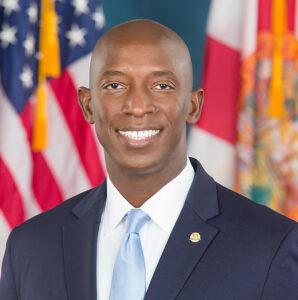


Florida’s first Black governor faces questions about whether his opposition to DEI programs and emphasis on merit-based competition will expand economic opportunity or reinforce longstanding barriers for Black entrepreneurs.
By James Posse
As Byron Donalds prepares to become Florida’s first Black governor, his commitment to maintaining restrictions on diversity, equity and inclusion programs is raising questions about the future of Black-owned businesses in a state where access to capital, government contracts and economic opportunity has never been equally distributed.
Donalds, a Republican and close ally of President Donald Trump, has consistently argued that business success should be determined by qualifications, performance and individual merit rather than racial considerations.
But his position presents a fundamental challenge for Black entrepreneurs: How can businesses compete on merit when they do not begin with equal access to the resources necessary to succeed?
In an exclusive interview published in M•I•A MEDIA GROUP’s 2026 Legacy Political Edition, Donalds defended Florida’s approach to diversity initiatives.
“I support Florida’s decision to end government-funded DEI. I believe in diversity, and I believe in merit,” Donalds said.
He maintained that government should provide equal opportunities rather than guarantee equal outcomes, while acknowledging that discrimination continues to exist and promising to enforce laws prohibiting it.
His position reflects a broader conservative argument that eliminating racial preferences creates a fairer marketplace where businesses compete based on ability rather than identity.
However, critics of that approach contend that removing targeted assistance without addressing longstanding economic disparities could leave qualified Black entrepreneurs at a competitive disadvantage.
The Difference Between Merit and Opportunity
For Black business owners across Miami-Dade, Broward and Palm Beach counties, the debate extends beyond political ideology.
Access to financing, bonding capacity, established business relationships and government procurement opportunities often determines whether companies can compete for major contracts.
Consider two construction companies pursuing a $2 million government project. Both possess the technical expertise, workforce and experience necessary to complete the assignment.
One company has substantial financial reserves, longstanding banking relationships and the bonding capacity required to qualify.
The other, despite comparable qualifications, struggles to secure financing and satisfy the contract’s financial requirements. The second company could be eliminated before its proposal receives meaningful consideration.
The hypothetical illustrates a central concern among advocates for minority business development: Equal bidding requirements do not necessarily create equal competitive conditions.
For businesses historically excluded from financing networks and major contracting opportunities, the obstacles can arise long before merit is evaluated.
Government Contracting Could Become a Critical Test
Florida’s procurement policies could provide one of the earliest indications of how Donalds’ economic philosophy affects Black-owned businesses.
Government contracts represent important opportunities for companies seeking to expand operations, hire employees and establish financial stability. Yet smaller businesses frequently encounter barriers involving insurance requirements, bonding, working capital and limited access to procurement information.
Without effective outreach and technical assistance, established contractors may continue dominating opportunities regardless of whether smaller competitors can perform the work.
The distinction between DEI restrictions and minority business development programs is important. Florida’s restrictions do not automatically eliminate every certification, outreach initiative or small-business assistance program.
The incoming administration’s decisions about funding, implementation and enforcement will determine which programs remain available and how effectively they serve underserved entrepreneurs.
For Black business organizations, the central concern is whether eliminating race-conscious policies will be accompanied by meaningful efforts to remove financial and institutional barriers.
Can Florida Truly Operate as a Meritocracy?
Donalds has described Florida as a meritocracy, emphasizing that individuals and businesses should advance based on their abilities.
Supporters argue that such an approach encourages entrepreneurship, rewards innovation and prevents government from favoring businesses because of race. Critics question whether that philosophy adequately accounts for differences in accumulated wealth, access to financing and professional networks.
A company with decades of established banking relationships may enjoy advantages unavailable to an equally capable business entering the marketplace. Those differences do not necessarily reflect superior performance. They may reflect access to resources accumulated over generations.
For Black entrepreneurs, the challenge is not simply demonstrating qualifications. It is obtaining the financial and institutional support necessary to compete. The question confronting the Donalds administration is whether its merit-based approach can address those disparities without relying on racial preferences.
South Florida’s Black Business Community Has Much at Stake
The consequences could be particularly significant in South Florida, where Black-owned businesses contribute to employment, neighborhood revitalization and economic development.
From Miami Gardens and Liberty City to Lauderhill, Fort Lauderdale and Riviera Beach, entrepreneurs continue navigating rising commercial rents, insurance expenses and financing challenges.
Access to government contracting can provide the revenue necessary for smaller companies to expand, create jobs and build long-term wealth.
Business advocates have consistently emphasized the importance of capital, procurement transparency, technical assistance and stronger relationships between minority-owned companies and major institutions.
Those priorities will remain relevant regardless of the governor’s position on DEI. Donalds could demonstrate that his economic approach works by expanding access to financing, simplifying procurement requirements and ensuring that qualified small businesses can compete for state contracts.
His administration could also publish detailed contracting data showing whether opportunities are reaching historically underserved communities. Such reporting would provide a measurable way to evaluate whether the state’s policies are expanding competition or preserving existing disparities.
A Historic Governor Faces an Economic Test
Donalds’ election represents an important milestone in Florida’s political history. But the significance of having the state’s first Black governor will ultimately depend on more than representation.
His administration will inherit an economy in which many Black entrepreneurs continue confronting obstacles that cannot be explained solely by individual effort or business performance. The challenge is not whether merit should determine success. Few would dispute that businesses receiving public contracts should demonstrate competence, accountability and the ability to deliver results.
The more difficult question is whether Florida’s economic system provides qualified businesses with a fair opportunity to demonstrate those capabilities.
Donalds has an opportunity to show that a government committed to merit-based competition can also confront longstanding inequalities in access to capital and contracting.
That will require more than eliminating racial classifications. It will require policies that address unnecessary barriers, expand financing opportunities and ensure transparency in how public contracts are awarded.
For Black entrepreneurs, the results will be measured in contracts secured, businesses expanded, employees hired and wealth created.
Florida’s first Black governor has promised an economy where merit determines success. His greatest challenge may be proving that merit can truly prevail in a marketplace where opportunity has never been equally accessible.
The question is not whether Black businesses deserve preferential treatment. It is whether they will receive fair treatment. And for the Donalds administration, that distinction could become one of the defining economic tests of the next four years.