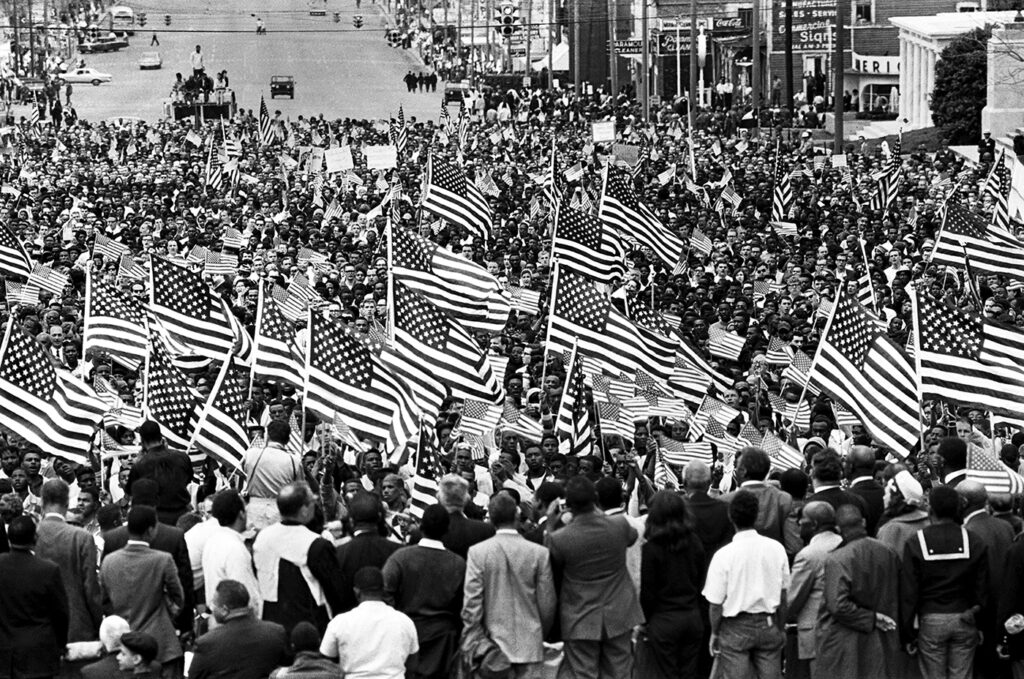



 March 7 marks the 61st anniversary of “Bloody Sunday.” On that day in 1965, a group of nonviolent demonstrators—led by John Lewis and Hosea Williams—attempted to cross the Edmund Pettus Bridge in Selma, Ala., beginning a planned march to the state capital in Montgomery.
The march was a pivotal escalation of the Alabama Movement, a joint effort by the Southern Christian Leadership Conference and the Student Nonviolent Coordinating Committee to challenge the entrenched disenfranchisement of Black Southerners. Only a week earlier, law enforcement officers had violently attacked citizens in Marion who were simply trying to register to vote. During the assault, police shot Jimmie Lee Jackson, a young Black laborer, as he tried to shield his mother and grandfather. Jackson later died from his injuries, galvanizing activists across the state.
That same pattern of brutal resistance confronted the marchers on Bloody Sunday. As they stepped off the Edmund Pettus Bridge, Alabama State Troopers advanced on the crowd with billy clubs, tear gas, and mounted units. Men, women, and children were beaten and trampled. John Lewis suffered a fractured skull. Amelia Boynton, co-founder of the Dallas County Voters League, was beaten unconscious. Images of the violence shocked the nation as they appeared in newspapers and on television broadcasts around the world.
Among the witnesses was photographer James “Spider” Martin, on assignment for the Birmingham News. Risking his own safety, Martin captured some of the era’s most searing images. His photographs not only documented the assault but also shaped public opinion and helped build momentum for the struggle that continued over the following weeks to complete the march from Selma to Montgomery.
We know how that struggle ultimately changed the nation. On August 6, 1965, President Lyndon Johnson signed the Voting Rights Act into law—one of the most significant civil rights achievements in American history. That victory followed a decade of sustained, courageous activism by people of all backgrounds who exercised their constitutional rights to demand justice. Leaders like Dr. Bernard Lafayette, who recently passed away at age 85, spent years in Selma building the local coalitions that made the movement possible. Hundreds of others from across the country joined the effort, risking their livelihoods and their lives. Some, including Jimmie Lee Jackson, Rev. James Reeb, and Viola Liuzzo, paid the ultimate price.
The Spider Martin photographs currently on display at the African American Research Library and Cultural Center offer a stark reminder of the painful, determined journey that helped lift the nation out of the shadow of Jim Crow. They bear witness to how hundreds—and eventually thousands—of ordinary people stood together in the face of overwhelming force and prevailed. As the exhibition’s title declares, Selma is Now.
Tameka Bradley Hobbs, Ph.D., is a historian, author, and president of the South Florida Branch of the Association for the Study of African American Life and History.
