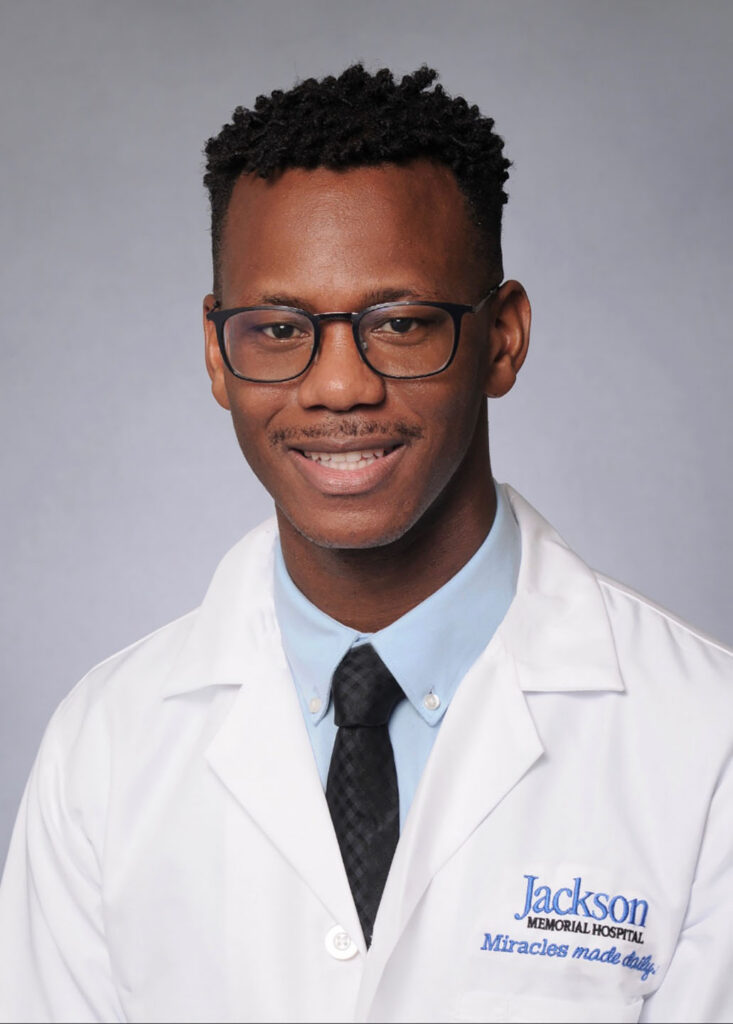







While in medical school, Lavarr Farmer, M.D. witnessed a stroke patient move again. The drug was tPA, a clot-buster that can be used, under certain circumstances, to treat stroke. What happened once it took hold changed the way he viewed neurology.
“[It made] me really appreciate neurology,” he said. For Farmer, it was a glimpse of what the field could do.
Born and raised in Miami, he attended Florida International University and, before beginning his training, conducted infectious-disease research in the community he now serves. When it came time to choose a residency program, he ranked the University of Miami No. 1.
Staying home, he said, was “the most natural option.”
“And here I am now.”
Today, Farmer is a fourth-year neurology Resident at the University of Miami Miller School of Medicine. He began the program in 2023 and is now in his final year, which is also his chief year.
A former college athlete with a longstanding interest in science, he reflected he was naturally drawn to the connection between brain and body. But it is what remains unsolved that continues to fascinate him.
“There is so much that is unknown about the brain,” he said. “It’s an organ just waiting to be demystified.”
Those unanswered questions are part of what makes complex cases appealing to Farmer.
He is particularly interested in status epilepticus, prolonged seizures that can force physicians to search for the treatment regimen that finally brings a patient back.
“Finding the right formula of medications to treat these patients and see them recover is mentally rewarding,” he said.
He also plans to subspecialize in interventional pain and has a particular interest in migraine cases. Those patients, he said, can be medically complicated, making it especially gratifying when a treatment finally works.
One migraine patient in particular has stayed with him.
She had traveled from another city seeking help for severe headaches. Previous treatment had brought no relief, and she feared she would have to live with the debilitating condition indefinitely.
Farmer recognized that some of her lifestyle choices were worsening her symptoms and that her prescriptions were not serving her well. Once he understood what was happening, he said, he was able to help her quickly.
Medicine’s demands make taking care of himself important, too. He stays active and works out regularly, relying on the gym to relieve stress.
“This helps me to prevent burnout and I am able to work hard for my patients on a daily basis,” he shared.
Just as important to him is that more people understand the reach and complexity of his specialty. Neurology, he said, involves far more than the brain. It includes diseases of the spine and peripheral nerves, as well as problems involving communication between the body and muscles.
“There is a ton that we know about neurology, but again, there is so much waiting to be discovered,” he said.
For the career ahead, his goals extend beyond the patients he will treat.
He hopes to open doors for the next generation and show younger people that their ambitions can carry them further than they imagined, and to leave the field, “a little better than I found it.”
