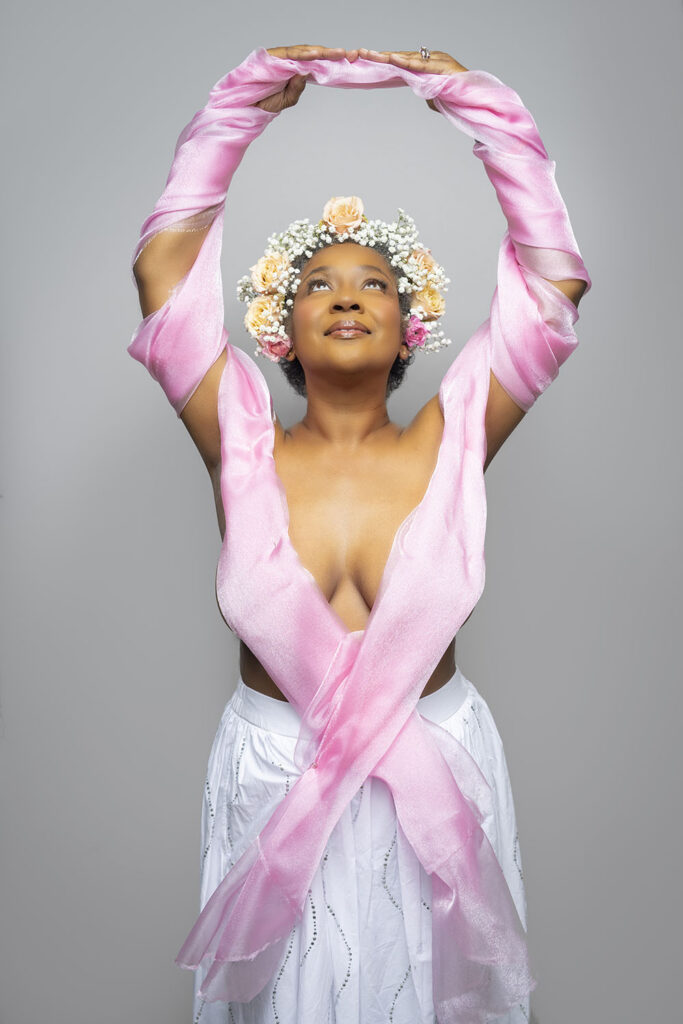







Kimberly Gray Roberts was busy living her best life. She was writing other people’s stories, running her marketing company, and serving as chief operating officer for two of her husband’s ventures. So, when she received not one, but two letters in January stating her annual mammogram was negative, she exhaled a sigh of relief and kept it moving.
When a third letter arrived at her home asking her to repeat the procedure, she shrugged it off. “I’m good, “ the 55-year-old frequent contributor to Legacy Magazine recalls thinking. “I do my breast exam every morning in the shower and I have two letters saying I’m fine. Why would I go back?”
In July, that question was answered. During a visit to her primary doctor the physician informed her that another mammogram wasn’t optional, which led to further testing. Those tests indicated she has a form of breast cancer known as Ductal Carcinoma in Situ, (DCIS) in which abnormal cells line the milk ducts but have not broken through the duct walls.
Every year approximately 40, 000 black women are diagnosed with breast cancer according to the Breast Cancer Research Foundation. While White women have a slightly higher overall rate of breast cancer, Black women have a higher risk of dying from the disease and developing aggressive forms at younger ages, according to the Centers for Disease Control and Prevention. Experts say those statistics are driven by healthcare inequities, socioeconomic barriers and biological differences.
Roberts says initially she had a “melt down” when she heard a mastectomy was the best plan of treatment because of how extensive the cancer is throughout her breast. Roberts says she elected to have both breasts removed to reduce the chance of cancer spreading or reoccurring. She plans to have breast reconstruction surgery. She is grateful she won’t have to undergo chemotherapy or radiation.
The diagnosis has the usually upbeat Roberts vacillating between acceptance and fear. “Of course I’m scared, I’ve never had surgery before,” she says. “It isn’t pretty and some days all I want to do is lay in my bed and cry,” she says.
One day when she was crying in the shower, a place she finds refuge from reality, Roberts says she heard the firm and loving voice of her deceased grandmother. “What is crying going to solve,?” her grandmother asked. Roberts says she looked around the room for the woman who was her “everything” and realized it was her imagination wrapped in a wakeup call from on high.
“My grandmother was right. I wish my story was different, but it isn’t,” she says.
Fortunately for Roberts, she isn’t facing it alone. She has the support of her husband, Ruban, and a host of friends and family who do whatever it takes to keep her spirits lifted.
“There’s still a whole lot of world out there for me to see and things I want to do,” says Roberts. “I’m looking at this as a slight bump in the road.”
