




By Legacy Editorial Staff
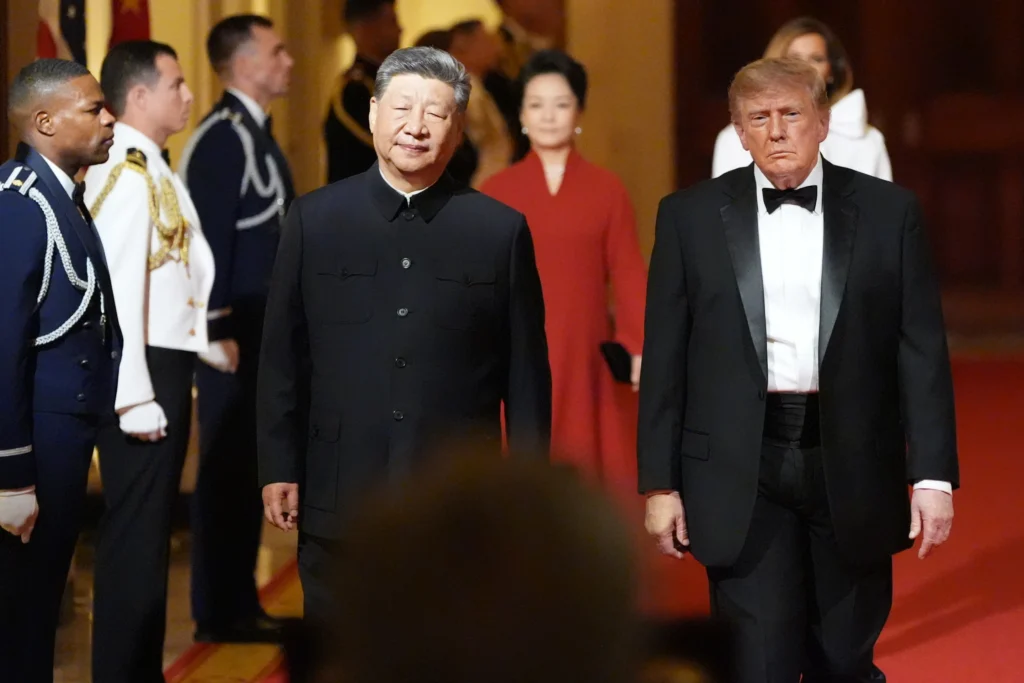
There is no verified basis for stating that President Donald Trump welcomed Chinese President Xi Jinping to Washington “this week.” As of June 2024, Trump was not president, and Xi had not made a recent official visit to Washington. The premise of a current Trump-Xi meeting therefore cannot be substantiated without a specific date and source.
The broader trade conflict between the United States and China is real, but its current terms depend on the date of publication. During Trump’s first administration, the United States imposed tariffs on hundreds of billions of dollars in Chinese imports under Section 301 of the Trade Act of 1974. China retaliated with tariffs on U.S. goods. President Joe Biden retained most of those tariffs and, in May 2024, directed the U.S. Trade Representative to increase tariffs on selected Chinese products, including electric vehicles, batteries, solar cells, semiconductors, steel and aluminum. The changes were scheduled to take effect in stages, with some rates beginning in 2024 and others later.
Those policies do not establish that every increase in consumer prices was caused by tariffs. Prices also reflect transportation costs, labor, energy, exchange rates, supply disruptions and business decisions. Tariffs are paid to the U.S. government by importers of record. Businesses may absorb the cost, negotiate with suppliers, change sourcing or pass some or all of the expense to customers.
That calculation can be especially difficult for smaller businesses.
Black Businesses Face an Unequal Burden
Black-owned businesses are disproportionately represented among smaller enterprises, according to federal business data, although the exact share varies by definition, industry and survey. Smaller companies often have less purchasing power, fewer supplier alternatives and less cash available to absorb unexpected costs than large corporations.
The consequences can be especially visible in beauty and personal care.
Black-owned beauty-supply stores, salons, barbershops and hair-care companies may rely on international supply chains for wigs, hair extensions, salon equipment, packaging, electronics and other products or components. Many such goods are manufactured overseas, including in China, but the country of origin varies by product and supplier.
When tariffs apply to an imported item, the wholesale cost may rise before the product reaches a store shelf or salon. Business owners may then raise prices, accept lower margins, renegotiate with suppliers or seek alternative sources.
Changing suppliers is not necessarily a complete solution. Moving production from China to another country can involve new shipping, compliance, quality-control and inventory costs. In addition, U.S. trade policy has included tariffs and other restrictions affecting imports from multiple countries and product categories, so the effect depends on the specific item and its tariff classification.
The problem extends beyond beauty.
Black-owned restaurants may face higher costs for imported equipment, furniture, packaging or ingredients, depending on the product and its origin. Retailers may pay more for clothing, electronics and merchandise. Construction and home-improvement companies may encounter higher costs for tools, machinery and materials. Online sellers can be particularly vulnerable when a small increase in landed costs erodes an already narrow margin.
Access to capital adds another dimension.
Research has documented racial disparities in business ownership, lending and access to capital, although outcomes differ by lender, industry, location and the characteristics of individual firms. A company with limited cash reserves may have less ability to purchase inventory in advance, absorb higher costs or wait for a supplier transition.
The effect of any tariff therefore depends on the product, the applicable rate, the importer’s contracts and the company’s ability to adjust.
The pressure can also reach families.
Rep. Ayanna Pressley, D-Mass., has advocated for reducing or eliminating tariffs on certain essential goods, including infant products. However, claims that she “repeatedly urged” the administration to exempt a specific list of car seats, strollers, cribs and highchairs should be tied to a particular bill, letter or congressional action before publication. Without that documentation, the broader statement is safer: lawmakers have proposed tariff exclusions and relief for consumer goods, but the scope and status of those proposals must be verified.
Agriculture represents another major fault line.
China has been an important market for U.S. agricultural products, including soybeans. During the 2018-19 trade conflict, Chinese retaliatory tariffs contributed to a sharp decline in U.S. agricultural exports to China, and the federal government provided billions of dollars in assistance to affected farmers. The size and timing of the impact varied by commodity, farm and year. Current trade data should be checked against the latest U.S. Department of Agriculture and Census Bureau releases rather than described with an undated generalization.
Black farmers enter that market from an already difficult position. The U.S. Department of Agriculture and civil-rights researchers have documented long-standing discrimination and unequal access to land, credit and federal programs. The number of Black farmers and the amount of land they operate have declined substantially over generations, although the precise figures depend on the census year and definition used. For farmers with limited acreage or financial reserves, losing an export market or receiving lower commodity prices can be consequential.
The administration supporting tariffs typically presents them as tools to address unfair trade practices, protect strategic industries, encourage domestic production and strengthen negotiating leverage. Critics argue that tariffs can raise costs for U.S. importers and consumers, invite retaliation and fail to produce domestic capacity quickly enough to offset the disruption. The economic outcome depends on the product, the policy design and the response of businesses and trading partners.
The United States and China remain deeply connected economically while competing over technology, manufacturing, security and geopolitical influence. China is a major supplier or processor of several critical minerals and materials, including many rare-earth elements. The United States has sought to diversify supply chains and expand domestic and allied production, but reducing dependence takes time and requires investment.
Any assessment of a Trump-Xi meeting must therefore begin with a verified date, location and agenda. It should then identify the specific tariff rates, exclusions, enforcement measures and commitments announced by both governments. Without those details, claims about lower tariffs, stronger agricultural exports or consumer relief are predictions, not established results.
For Black entrepreneurs, the practical questions are more immediate: Which products are covered? Who pays the tariff? Can suppliers be changed? Will customers accept higher prices? And can the business maintain payroll, inventory and investment while policy remains uncertain?
Across South Florida and the nation, the effects of U.S.-China trade policy will be measured not by diplomatic ceremony alone but by documented changes in import costs, agricultural sales, supply-chain reliability and consumer prices. Whether another generation of Black-owned businesses can keep its doors open will depend on those conditions, as well as access to capital, local demand and the broader economy.
