





House Democrats backed the Brooklyn congressman 251-11 on Wednesday. The full House will elect its speaker when the new Congress convenes Jan. 3.
By Marcus Ellison | M•I•A MEDIA GROUP
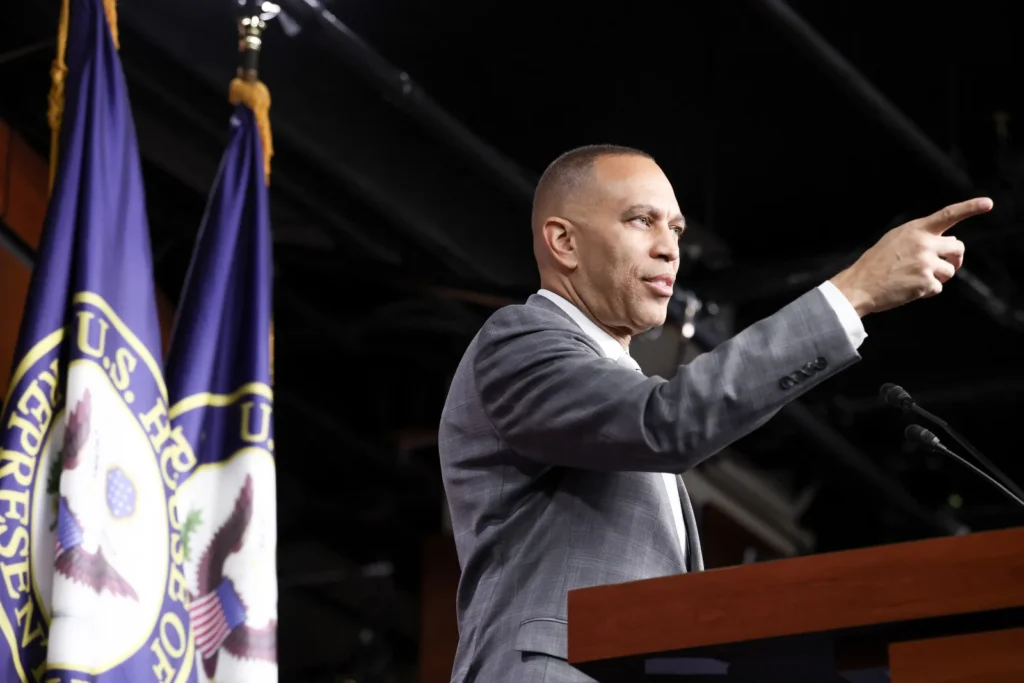
WASHINGTON — House Democrats nominated Hakeem Jeffries for speaker Wednesday, putting the New York congressman on the threshold of a milestone that has eluded the country for more than two centuries. If he wins the January floor vote, Jeffries will become the first Black American elected speaker of the U.S. House of Representatives.
Jeffries secured the nomination 251-11 in a closed-door vote that included returning lawmakers, members-elect and House delegates, The Associated Press reported. The next vote will take place in public. When the new Congress convenes Jan. 3, members of the full House will vote by roll call to elect a speaker. With all 435 members voting for a named candidate, a majority requires 218 votes.
Jeffries has already made history once. After Nancy Pelosi stepped aside from Democratic leadership in 2022, House Democrats chose him as her successor, making him the first Black person to lead a major political party in Congress. He assumed the role as Democrats entered the minority in January 2023. Now, with Democrats preparing to take the majority after the midterms, Jeffries has a chance to lead the entire chamber.
From Brooklyn to the speaker’s race
Born in Brooklyn, Jeffries served in the New York State Assembly before entering Congress in 2013. He rose through the House ranks as a Congressional Black Caucus whip and later as chair of the House Democratic Caucus. In 2020, he was among the House managers who presented the case in President Donald Trump’s first Senate impeachment trial.
Among those who spoke in support of his nomination Wednesday was Rep. James Clyburn of South Carolina. Rep. Kweisi Mfume of Maryland, who first entered Congress in 1987 alongside the late Rep. John Lewis of Georgia, also marked the significance of the vote. Their support linked Jeffries’ bid to generations of Black lawmakers who built influence in Congress through committee work, coalition-building and party leadership.
Wednesday’s vote also showed where some of Jeffries’ work begins. A group of incoming progressives withheld support and said they wanted stronger assurances about their priorities. With a broad majority of Democrats behind him, Jeffries enters January in a strong position. Keeping that coalition together through spending fights and negotiations with the White House will demand more than winning a leadership vote.
What the gavel would change
As minority leader, Jeffries has been the chief spokesperson and negotiator for House Democrats. As speaker, he would have greater influence over which bills reach the floor, when lawmakers vote and how the House approaches negotiations over federal spending. His first months would offer a measure of how Democrats intend to use the majority voters handed them.
For Black communities in South Florida, that agenda has practical stakes. Decisions on housing assistance, health coverage, infrastructure and federal contracting can affect a family trying to stay in its neighborhood, a clinic serving uninsured patients or a small business competing for its first government contract. A speaker can help bring those issues to a vote. Turning them into law still requires agreement with the Senate and, in most cases, the president’s signature.
Jeffries’ rise also carries meaning beyond any single bill. More than 150 years have passed since the first Black lawmaker was elected to the House. A Black speaker would occupy a position that helps determine what the chamber debates and which decisions members must defend to their constituents. That authority is central to what would make the January vote historic.
On Wednesday, Democrats made their choice behind closed doors. In January, the country will be able to hear each member’s vote. If Jeffries wins, he will take the gavel as the first Black speaker in American history, with the responsibility of leading a House whose decisions will reach far beyond Washington.