


By Donald Allwood
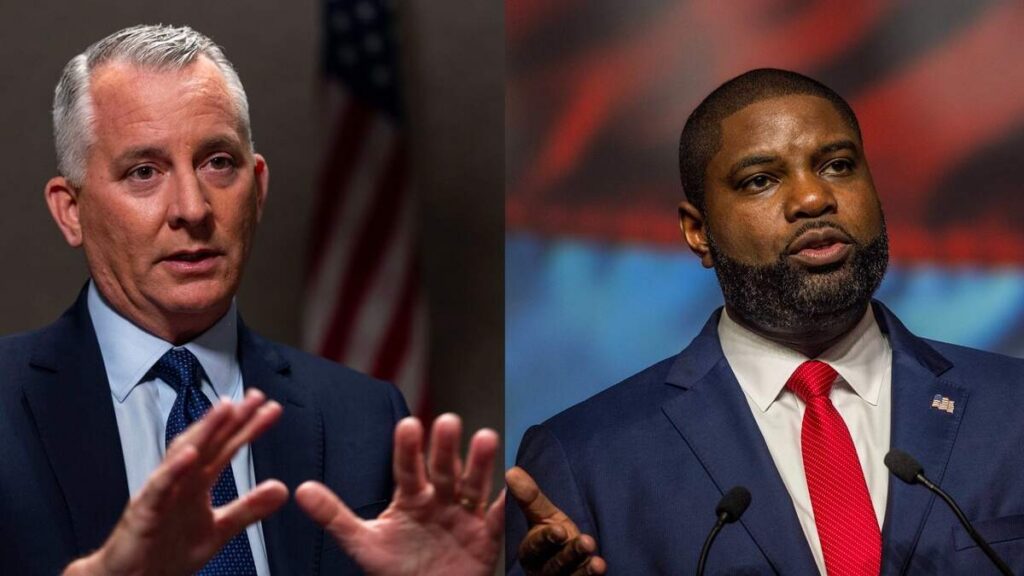
With Election Day approaching, Republican Byron Donalds holds the advantage in statewide polling, although one major survey shows Democrat David Jolly within striking distance.
Florida’s race for governor is entering its final stretch with Republican U.S. Rep. Byron Donalds leading Democrat David Jolly in most statewide polls. But beneath those numbers lies a more complicated political picture: A contest that appeared firmly in Republican hands has become increasingly competitive in some surveys, raising questions about voter turnout, independent voters and whether Democrats can mount a serious challenge in a state increasingly dominated by Republicans.
With the Nov. 3 election approaching, the latest polling offers two different perspectives on the race.
A University of North Florida poll released Oct. 21 found Donalds leading Jolly by just two percentage points, 49% to 47%, with 4% undecided. The survey of 1,471 likely voters, conducted Oct. 12-19, carried a margin of error of plus or minus 2.81 percentage points.
That places the candidates in a statistical dead heat, meaning the survey cannot establish with confidence which candidate is actually ahead among Florida voters.
University of North Florida poll
October 12–19, 2026 · 1,471 likely voters
Byron Donalds (R) 49%
David Jolly (D) 47%
Undecided 4%
Donalds +2 points · Margin of error ±2.81 percentage points
Yet another recent survey suggests Donalds maintains a considerably stronger advantage.
A co/efficient poll conducted Oct. 18-20 found Donalds leading Jolly 49% to 40%, a nine-point advantage. The survey included 1,014 likely voters and had a margin of error of plus or minus 3.1 percentage points.
The difference between these two polls illustrates the uncertainty surrounding the contest. While both place Donalds ahead, they offer significantly different assessments of Jolly’s ability to close the gap.
Polling averages favor Donalds
Despite the close University of North Florida findings, broader polling averages continue to favor the Republican candidate.
RealClearPolling’s average through Oct. 20 shows Donalds receiving 48.6% support compared with Jolly’s 43%, a 5.6-point advantage.
Other surveys have produced varying results, including a St. Pete Polls survey showing the candidates tied at 45% and a Stetson University poll placing Donalds ahead by 11 points.
The overall picture suggests Donalds remains the front-runner, but the size of his advantage depends considerably on which survey is examined.
Black voters could play a decisive role
For Florida’s Black communities, the election represents more than a contest between two candidates. It will help determine the state’s direction on public education, economic opportunity, housing affordability, civil rights and diversity, equity and inclusion policies.
Donalds, a Black Republican closely aligned with President Donald Trump, has emphasized conservative economic policies, school choice and opposition to government-funded DEI initiatives.
Jolly, a former Republican congressman running as a Democrat, has presented himself as an alternative to Florida’s current political leadership, emphasizing public education, civil rights and a more inclusive approach to state government.
The University of North Florida poll found Donalds receiving approximately 10% support among Black voters, according to the university’s analysis. That finding suggests he faces considerable challenges expanding his appeal within a constituency that has traditionally favored Democratic candidates.
For Jolly, however, strong support among Black voters alone may not be enough. His campaign must also translate that support into turnout while attracting independent voters and Republicans dissatisfied with the state’s political direction.
The economy remains central to the election
Florida voters are confronting rising housing expenses, costly property insurance, concerns about wages and persistent affordability pressures.
The University of North Florida survey found voters nearly evenly divided over which candidate they trusted more on affordability and the cost of living. Jolly received 43% compared with Donalds’ 42%.
On property insurance, Donalds performed better, receiving 43% compared with Jolly’s 38%.
Those findings underscore an important political reality: Neither candidate has established overwhelming voter confidence across the economic issues affecting Florida households.
A race that could come down to turnout
Florida’s Republican voter registration advantage presents a significant structural challenge for Democrats. Nevertheless, the University of North Florida survey suggests that Donalds’ lead has narrowed from five points in July to two points in October.
Sean Freeder, faculty director of the university’s Public Opinion Research Lab, described the contest as competitive enough that either candidate could win, given the survey’s margin of error.
That does not erase Donalds’ advantage in polling averages. It does, however, suggest the outcome is not guaranteed.
For Donalds, the objective is to consolidate Republican support, maintain his advantage among conservative voters and prevent Jolly from making further gains.
For Jolly, the challenge is more demanding: energize Democratic voters, win a substantial share of independents and persuade enough moderate Republicans to cross party lines.
The final days will test both campaigns’ organizational strength, messaging and ability to bring supporters to the polls.
The bottom line
As of Oct. 26, Byron Donalds leads David Jolly in the latest statewide polling averages, but the University of North Florida survey indicates the race could be considerably closer than those averages suggest.
The difference between a two-point contest and a nine-point advantage is substantial. It means voters should view individual polls as snapshots rather than predictions of the final outcome.
For Black Floridians and other communities concerned about the state’s economic and political future, the stakes extend far beyond the candidates themselves.
Florida’s next governor will influence decisions affecting schools, businesses, public services, civil rights and economic opportunity for years to come.
With Election Day approaching, the clearest conclusion is that Donalds remains the polling favorite, while Jolly still has a potential path to victory.
