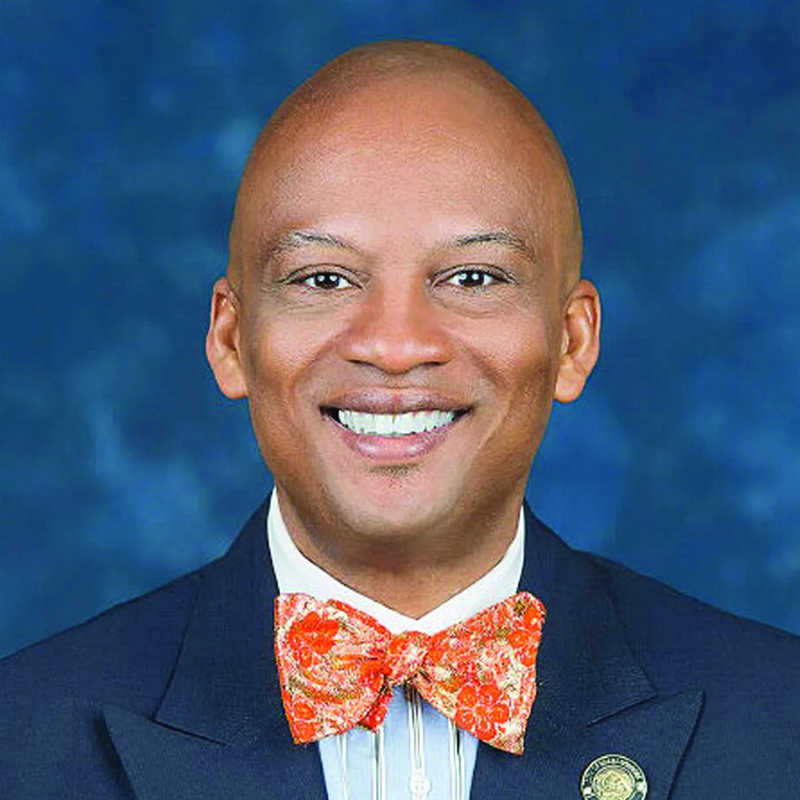








By Stephen Hunter Johnson, Esq.
Why I Support Oliver Gilbert for Congress
Miami-Dade County attorney; former general counsel of the Miami-Dade Democratic Executive Committee; and former chair of the Miami-Dade County Black Affairs Advisory Board
Elections are too often reduced to personality, slogans and promises. But the choice before voters in Florida’s 24th Congressional District should be judged by a more demanding standard: Who has the clearest vision — and the demonstrated ability to turn that vision into measurable results?
By that standard, Oliver Gilbert is the clear choice for Congress.
I have had the honor of knowing and working directly with nearly all of the Democratic candidates in this race. The exception is Kendrick Meek Jr., whom I had not encountered in community advocacy before this election.
My relationships with the other candidates span years. I served as general counsel during state Sen. Shevrin Jones’ tenure as chair of the Miami-Dade Democratic Executive Committee. I chaired the Miami-Dade County Black Affairs Advisory Board while Jean Monestime was chairman of the County Commission. I collaborated with Rod Vereen during his unsuccessful campaign for Miami-Dade state attorney. I hosted my first political rally at Marshall Davis’ African Heritage Cultural Arts Center. Dr. Rudolph Moise is my primary care physician.
I know these candidates well. I respect their service. But I also know their records.
What distinguishes Gilbert is that he has consistently executed and delivered on his vision — not simply of what a community is, but of what it can become.
I can point to parks, public infrastructure, thriving businesses, innovative community programs and stronger neighborhoods that are better because Gilbert did the work. He has not merely spoken about transformation. He has governed through it.
When Gilbert became mayor of Miami Gardens, he inherited a city fighting an outdated and unfair reputation. Businesses had been reluctant to invest. Parks needed attention. Residents lacked confidence in their police department.
Gilbert went to work.
As mayor, his administration expanded and redeveloped parks, increased civic engagement, encouraged economic development and helped attract businesses that once might not have considered the city. He confronted problems within the Police Department and pushed reforms intended to rebuild trust, including efforts to recruit officers from the communities they served.
In 2020, Miami Gardens was named an All-America City by the National Civic League, recognizing the city’s civic engagement, collaboration, inclusiveness and innovation in addressing community challenges.
Gilbert helped change not only how Miami Gardens functioned, but how residents saw their city — and how the rest of South Florida saw it. He also fought to secure greater zoning authority for Miami Gardens over Hard Rock Stadium, an enormously important asset within the city’s boundaries.
Gilbert continued that results-driven approach after joining the Miami-Dade County Commission.
As a commissioner and later chairman of the commission, he helped secure more than $25 million for a performing arts center in Miami Gardens. That investment promises a permanent home for culture, education and economic activity in a community that has too often been asked to travel elsewhere for first-class public amenities.
He also committed public resources to septic-to-sewer conversions and private-side connections for residents who could not afford those costs themselves.
That work is not glamorous. It does not always generate headlines or viral social media clips. But it is exactly what effective government looks like. It protects homes, improves public health, strengthens property values and helps preserve our environment.
Working with state Rep. Felicia Robinson, Gilbert also took his advocacy to Tallahassee, fighting water surcharges affecting Miami Gardens and parts of unincorporated Miami-Dade County and helping secure a $9 million settlement for the city.
That is the kind of record voters should examine when deciding whom to send to Washington.
Gilbert has also articulated a vision for South Florida’s future that includes the rapid mass transit this region desperately needs. He understands that South Florida cannot build its future around more traffic, longer commutes and increasingly frustrated residents.
He has stood with working families and organized labor. He has pushed for public contracting and business opportunities that allow small and Black-owned businesses to compete, grow and create jobs.
These are not theories. They are not campaign promises.
They are evidence of a philosophy of leadership that recognizes a simple truth: In public service, what ultimately matters is not what you say. It is what you do.
Elections sometimes force us to compare friends with friends.
Sen. Shevrin Jones is a good man who has served his constituents and championed important causes. As a state senator, he has operated in a political environment shaped by Gov. Ron DeSantis and a Republican-controlled Legislature that have advanced policies Jones strongly opposes.
Jones has distinguished himself as an advocate for the LGBTQ+ community. He stood with state Rep. Anna Eskamani in opposition to restrictions on gender-affirming care and delivered an emotional speech on the Senate floor during the 2022 debate over legislation critics labeled the “Don’t Say Gay” bill.
What I wish I could say is that his advocacy for Black Floridians has always been equally forceful.
When Debbie Wasserman Schultz entered the race for Florida’s 20th Congressional District, Jones issued a statement that praised her before criticizing her decision to enter the contest. When state Sen. Jason Pizzo delivered remarks on the Senate floor that I considered deeply offensive to the Black community during debate involving the same water surcharges Gilbert had fought, Jones remained quiet.
And when Jones, as chairman of the Miami-Dade Democratic Executive Committee, acknowledged that Black neighborhoods across the county had little to no Democratic signage ahead of an election, he recognized the problem but, in my view, failed to adequately correct it.
The central question is not whether Jones has served people or done meaningful work. He has done both.
The question is: Who has done more with the talent, authority and public trust entrusted to him?
On that question, I believe the contrast is unmistakable.
When the DeSantis administration approved controversial new standards for teaching Black history — including instruction about how enslaved people developed skills that could, in some circumstances, be applied for their “personal benefit” — Jones held a town hall to challenge the standards.
Gilbert responded differently: He worked to put “The 1619 Project” into the hands of high school students.
That distinction captures much of what this election is about for me.
Action over speeches.
Congress will require more than speeches and symbolic partisan opposition. It will require someone who can negotiate without losing sight of the community, build coalitions without abandoning principle and turn public dollars into visible progress.
Washington has no shortage of people who can identify problems.
District 24 needs someone with a demonstrated record of solving them.
Gilbert has taken on difficult assignments before. He helped transform a city, confront problems in a police department, rebuild public spaces, expand economic opportunity and direct county resources toward projects designed to improve people’s lives.
His record demonstrates an understanding of both the urgency of our challenges and the mechanics of government required to address them.
There is another lesson worth remembering.
When U.S. Rep. Frederica Wilson worked to establish the Commission on the Social Status of Black Men and Boys, Republican Sen. Marco Rubio of Florida sponsored the Senate legislation. Whatever their political differences, Wilson understood that accomplishing something in Washington sometimes requires building alliances beyond the people who already agree with you.
That was a measure of the respect Wilson had earned across the aisle — and of her political savvy.
It is also why her endorsement of Gilbert carries particular weight.
Wilson has represented this community in Congress. She understands what the job demands, knows the unfinished work of the district and has had years to observe the people now asking voters to succeed her.
She chose Gilbert.
She chose a man who rose to lead the Miami-Dade County Commission, a body composed of members with different political philosophies, constituencies and priorities. She made that choice knowing what Congress is and what this district needs.
Everyone in politics has words.
Gilbert has a record of turning words into work.
Wilson is hardly alone.
Gilbert has earned support from faith leaders, including Pastor Arthur Jackson III of Antioch Missionary Baptist Church, Pastor Richelle Lorde of Jesus People Ministries, Pastor Carl Johnson of 93rd Street Community Baptist Church and Bishop Jimmy Williams. Their support reflects confidence in his character, service and willingness to remain accountable to the communities he represents.
Teachers and working people have reached the same conclusion. United Teachers of Dade and the Broward Teachers Union have backed Gilbert, along with labor organizations including the Florida AFL-CIO, SEIU Local 1991, 32BJ SEIU and Transport Workers Union Local 291.
His supporters also include elected and civic leaders from across South Florida, among them Miami-Dade County Mayor Daniella Levine Cava, Miami Mayor Eileen Higgins, Miami Gardens Mayor Rodney Harris, Miami-Dade County Commissioner Micky Steinberg, state Reps. Wallace Aristide and Felicia Robinson, former state Rep. Phillip Brutus, Miami Gardens Councilwoman Linda Julien, Miramar Commissioner Yvette Colbourne, Miramar Vice Mayor Carson “Eddy” Edwards and Pembroke Park Commissioner and former Mayor Ashira Mohammed.
That coalition matters.
It crosses municipal and county lines and brings together institutions of faith, educators, labor organizations and public officials who serve working families every day. They will not agree on every issue. No meaningful political coalition does.
But they agree on something fundamental: District 24 needs a representative with the demonstrated capacity to govern, build partnerships and deliver results.
This election is not a popularity contest.
It is a job interview.
The résumé matters. The results matter. The ability to turn political power into tangible progress for the people matters.
Florida’s 24th Congressional District faces serious challenges — housing affordability, transportation, economic opportunity, infrastructure, public safety and the need to protect communities whose voices are too often marginalized in Washington.
The next member of Congress will not have the luxury of learning leadership on the job.
We need someone who has already demonstrated it.
For me, that person is Oliver Gilbert.
For those reasons, I support Oliver Gilbert for Congress, and I urge my fellow voters in Florida’s 24th Congressional District to do the same.
______________________________________________________________________________________
The views and opinions expressed in this article are those of the author and do not necessarily reflect the official policy or position of M•I•A MEDIA GROUP LLC. Any content provided by our contributors is their opinion and is not intended to malign any religion, ethnic group, club, organization, company, individual, or entity.
