




By Camille Bennett | M•I•A MEDIA GROUP
Political Analysis
Black and Hispanic voters often share concerns about housing costs, wages, health care and opportunity. Yet their choices at the ballot box can differ sharply, particularly in South Florida.
Understanding that divide requires looking beyond the assumption that minority communities should vote alike. Different histories, national origins, generations and experiences with government shape how voters assess the same candidates.
The premise also needs an important qualification: Hispanic voters are not uniformly Republican. Pew Research Center’s validated-voter analysis found that nationally, Hispanic voters narrowly favored Kamala Harris over Donald Trump in 2024, 51% to 48%. Black voters supported Harris by a much larger margin, 83% to 15%. Those figures describe the 2024 presidential election, not this week’s midterms.
Black Democratic Support Has Historical Roots
Black Americans’ relationship with the Democratic Party developed through major political changes.
After emancipation, Black voters largely identified with the Republican Party of Abraham Lincoln. During the Great Depression, many shifted toward Franklin D. Roosevelt’s Democratic coalition as New Deal programs offered economic relief. The civil rights struggles that followed further reshaped party loyalties and expectations of federal protection.
That history was complicated. Southern segregationists were powerful within the Democratic Party, while the landmark Civil Rights Act of 1964 required a bipartisan coalition. Black activists challenged discrimination within Democratic institutions as well as across American society.
The resulting political alignment reflects generations of debate over which party would more reliably protect voting rights, enforce equal treatment and expand opportunity. Describing Black Democratic support simply as habit overlooks that history.
It is also an alignment with variation. Pew found that Trump’s Black support increased from 8% in 2020 to 15% in 2024, even as Democrats retained a substantial majority.
“Hispanic” Encompasses Different Political Histories
South Florida’s Hispanic electorate includes people with roots in Cuba, Puerto Rico, Venezuela, Colombia, Nicaragua and numerous other places. Their experiences and political priorities cannot be reduced to one story.
For some Cuban Americans, exile and opposition to Cuba’s communist government have helped shape a longstanding Republican alignment. But Cuban voters themselves differ by generation, migration experience and other characteristics. Pew’s 2020 research documented a Republican advantage among Cuban registered voters while emphasizing how they differed from other Hispanic groups.
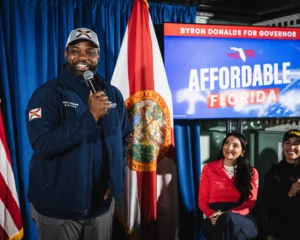
A Florida poll released by N+ Univision in October 2026 illustrated those distinctions. Cuban respondents favored Republican Byron Donalds for governor, while Puerto Rican respondents favored Democrat David Jolly. Across Hispanic respondents overall, Jolly led. These were pre-election preferences, not verified election results.
Hispanic identity also overlaps with race. Afro-Latino voters can be both Black and Hispanic, making a strict separation between the two categories misleading.
Economics, Religion and Identity Intersect
Neither electorate votes on racial or ethnic identity alone.
Research on Hispanic voting examines differences associated with religion, education, gender, age, ancestry and economic circumstances. Those relationships help explain variation, but do not establish a single cause for any person’s vote.
The October Univision poll found that jobs, living costs and housing ranked prominently among Hispanic Floridians’ concerns. It also found substantial concern about immigration enforcement. That combination challenges the idea that Hispanic voters can be understood primarily through immigration or presumed cultural conservatism.
A voter may favor lower taxes while supporting public health coverage, or want border enforcement while opposing particular deportation practices. Party choice involves weighing competing priorities.
Avoid Reading Individual Motives Into Neighborhood Results
Post-election maps can reveal where candidates performed well. They cannot establish how every Black or Hispanic resident voted, much less why.
A majority-Hispanic precinct includes voters from other backgrounds, and its Hispanic residents may represent several national-origin groups. Explaining this week’s results therefore requires careful survey evidence alongside precinct returns.
The broader lesson is that shared economic pressures do not automatically produce identical political judgments. Black and Hispanic voters bring different histories and perspectives to overlapping concerns.
The most useful question is which policies, experiences and candidates earned their confidence — and whether those elected will deliver the security and opportunity voters sought.