







By Tameka Bradley Hobbs, Ph.D.
 It is difficult to ignore the fact that so many of the intersecting negative forces unleashed by the current occupant of the White House have resulted in so much disruption in the lives of Black women. What does this mean for the mental and material health of such a vital segment of the Black community?
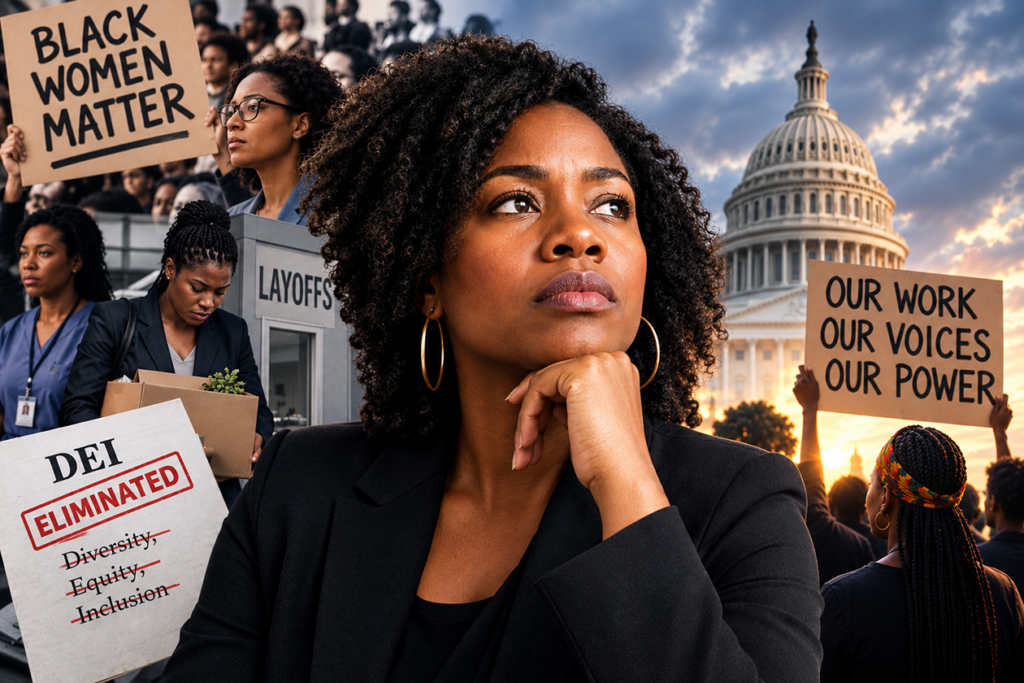
Since 2025, an astounding 600,000 Black women have been pushed from the labor force. This is in part due to Trump’s creation of the Department of Government Efficiency, or DOGE, and its leadership under the viciously incompetent Elon Musk. For Trump, Musk, and much of the Republican Party, government employees came to embody the epitome of government waste. Black women, who are highly represented among these civil service and public sector jobs, have suffered disproportionately.
Another target of the Trump administration’s ire, both during his previous and current terms, has been “DEI,” the straw man propped up as the focus of the Republicans’ culture wars. As the administration demanded the withdrawal of support for the diversity, equity, and inclusion efforts that swept the nation after the Racial Reckoning of 2020, the Black women who disproportionately filled the roles created by that upswing found themselves not only without work but also without what had been a burgeoning professional field. The idiotic, racist, and purely mean-spirited lens created by this Orwellian term came to stand for “Didn’t Earn It,” and tends to be applied to almost anyone with melanated skin who happens to occupy a position of influence or power. We have seen racist formation in President Trump’s repeated and failed attempts to remove Lisa Cook from her post on the Federal Reserve Board of Governors, as well as against New York Attorney General Letitia James.
These compounding attacks have been devastating. The unemployment rate for Black women hit 7.3% by the end of Trump’s first year in office. As Adia Harvey Wingfield warns in her article for Forbes.com, “the work Black women disproportionately do is essential yet largely unacknowledged and undervalued. Their mass exodus from the work force will thus likely have unanticipated, adverse consequences.”
Black women are caught in the nexus of the intersecting effects of a rise in rampant racism, as well as a rise in politically-informed misogyny which views liberal women voters as the root of “woke” politics. This twisted ideology not only welcomes women being dispelled from the workforce but also embraces their disenfranchisement, as is promised in the SAVE Act, which President Trump yearns to have enacted.
These widespread and unrelenting attacks call for an equal and opposite response in order to preserve the well-being of Black women. This is true because Black women play outsized roles in stabilizing and advancing the Black community. To paraphrase Anna Julia Cooper’s famous framing from her 1892 book, “A Voice From the South”, if Black women carry the entire race with them when they advance, what happens when their fates are systematically reversed?
Tameka Bradley, Ph.D., is a public historian, documentarian, and award-winning author. She is president of the South Florida Branch of the Association for the Study of African American Life and History.
