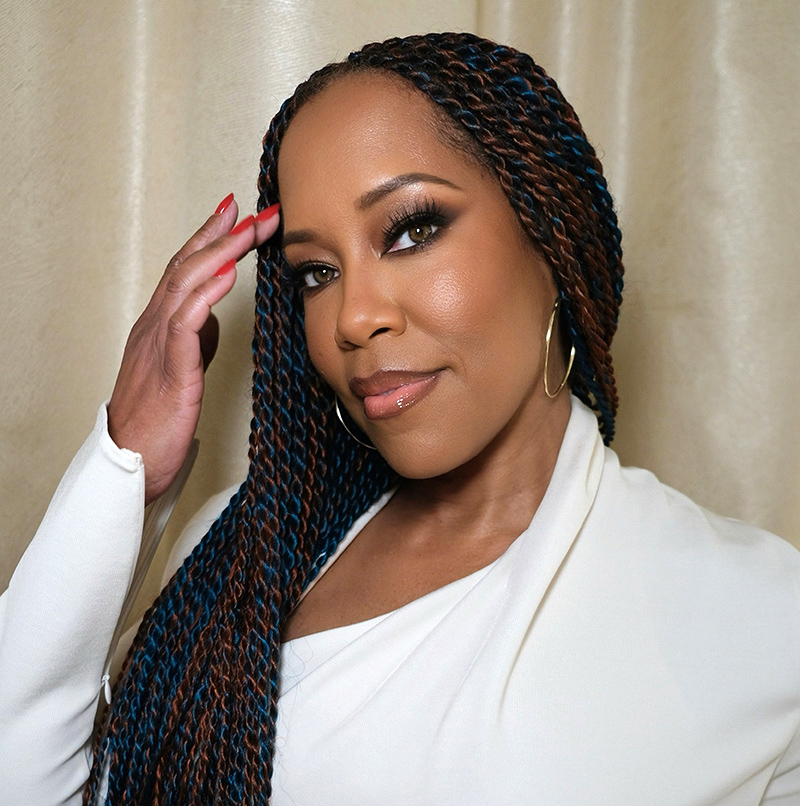



Regina King knows what it means to come home to a place that has grown alongside you and to a community you’ve helped shape. This spring, as the American Black Film Festival celebrates 30 years and returns to Miami Beach under the banner “Homecoming,” the Oscar, Emmy, and Golden Globe-winning actor and director steps in as the festival’s official ambassador—a role that feels less like a booking and more like a return with weight.
“Reaching our 30th anniversary is a milestone not just for the festival but for the creative community we’ve championed,” said NICE CROWD President Nicole Friday, whose company produces ABFF. “Our ‘Homecoming’ focus celebrates that journey—welcoming back legends like Regina King while introducing a new generation.”
The moment becomes a celebration of continuity: artists who changed the game and those now stepping onto the set.
For King, whose relationship with the festival dates back to its early days as the Acapulco Black Film Festival in the late 1990s, the partnership comes at a moment of reflection and intent.
“At this stage in my career, I’m thinking about legacy—not by looking backward, but by what I can help build forward,” she said. “This partnership gives me a chance to support the next generation while honoring the breadth of Black storytelling across generations.”
That idea of building forward runs through King’s four-decade career. From breakout roles in “227” and “Boyz N the Hood” to her Oscar-winning performance in “If Beale Street Could Talk,” she has consistently chosen to play women who are neither simple nor ornamental.
“The throughline is always humanity,” she said. “I’ve never been interested in playing women who exist only to serve the plot or stand in for an idea. I’m drawn to women carrying something—strength, contradiction, tenderness, pain, intelligence, survival.”
A conscious focus on interior life has shaped her work behind the camera. In 2020, King made history with her directorial debut, One Night in Miami, becoming the first Black woman to premiere a film at the Venice Film Festival and earning a Golden Globe nomination for Best Director.
“Directing felt like a natural evolution of what I had already been doing internally,” she said. “As an actor, I’ve always been deeply engaged with story, tone, and character. At a certain point, I wanted to shape the work as a whole.”
If representation once meant visibility—being seen in spaces where Black artists had been excluded—her understanding has sharpened with time and responsibility.
“It’s not just about being represented,” she said. “It’s about how we’re seen, who shapes that image, and whether the work allows for truth. Being behind the camera made me realize representation isn’t a box to check; it carries responsibility.”
That perspective aligns with ABFF’s evolution from a niche gathering to a global platform.
“Access has expanded in some ways, but true support and community are still rare,” King said. “A festival like ABFF isn’t just about exposure. It’s about connection, affirmation, and momentum.”
Black audiences are increasingly global and connected, and the festival’s reach is expanding alongside them.
“The opportunity now is to think bigger about whose work gets space and how we connect different Black experiences and cultures,” she said.
King is clear about the kind of artists she hopes to uplift in Miami.
“Storytellers with a clear point of view are the most compelling,” she said. “People who aren’t chasing imitation but bring something honest, specific, and fully their own.”
She gravitates toward work that is confident in its voice—projects that expand how Black life is seen.
“I’m especially interested in stories that make room for intimacy, imagination, joy, contradiction, and ambition.”
That vision mirrors what ABFF has cultivated over three decades: films made on shoestring budgets and studio scales, stories rooted in Liberty City or Lagos, and creators at every stage of their careers.
Friday calls the festival “a premier stage for bold storytelling,” and the anniversary slate—with screenings, conversations, and a “Legacy Talk” with King—reflects that extension.
For King, the ambition now is to do what matters rather than simply doing more.
“What excites me most is being intentional about where I put my energy and what I stand behind,” she said. “I’m drawn to stories that challenge me, to directing work at a deeper level, and to creating space for artists coming up behind me.”
In that sense, this “Homecoming” plays less as a return than as a recommitment. As ABFF marks three decades, Regina King comes to Miami not simply as an honoree but as a builder of opportunity and of a body of work that continues to expand how Black life is seen and understood.
