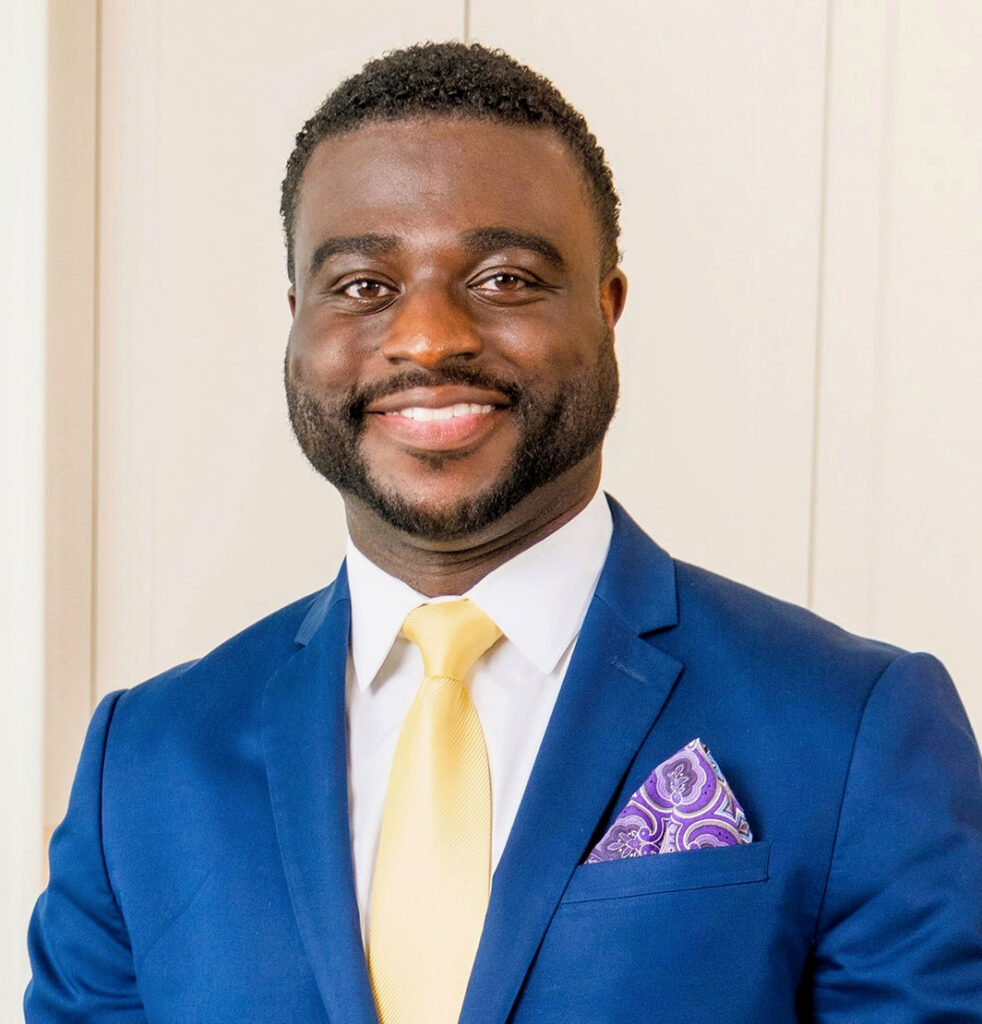








Chevone Davis-Raglan, PharmD, recently joined Eli Lilly, the world’s largest pharmaceutical company. In his role as a senior director and thought leader liaison, Davis-Raglan covers nine states in the Southeast working with gastroenterologists to gather insights and educate peers on treatment options for inflammatory bowel diseases. He is one of four people in the country with that role for Eli Lilly.
“From as young as 3 years old, my family would tell me, ‘You’re gonna be a doctor one day,’” he said.
Although Black doctors of all disciplines are underrepresented nationwide, those were lofty, but not impossible goals.
Conservative estimates from the American Association of Colleges of Pharmacy and the census place the percent of Black pharmacists somewhere between 5-8 percent. Fortunately for Davis-Raglan, his genetics and upbringing played a significant role in guiding his career.
Raised in Miramar, he is the son of Jamaican immigrants who were both the first in their families to graduate college. His mother earned a degree in zoology and chemistry, and his father studied computer systems analysis. Math and science came naturally to him.
As a teenager, he began to narrow down his career options. He wasn’t convinced the long-term commitment to become a physician was for him. However, pharmacy offered a faster route. His mother, who once considered the profession herself, pointed him toward Florida A&M University.
FAMU’s College of Pharmacy and Pharmaceutical Sciences program produces more than 20 percent of Black pharmacists in the country. For Davis-Raglan, earning a full-ride scholarship that covered his first four years made his decision to attend easy.
Ultimately, his family was correct. The bright toddler did grow up to be a doctor, just not in the traditional sense. He graduated with his PharmD at 23.
Davis-Raglan worked at a pharmacy throughout his studies and could’ve continued following graduation. Labor statistics estimates as much as half of American pharmacists work in retail. Davis-Raglan understood the appeal.
“The most accessible of any healthcare provider is a retail pharmacist,” he explained. “Anybody can walk into a pharmacy and get advice from a pharmacist about something,”
He also saw the toll of long shifts on his feet, with few breaks. He couldn’t imagine himself doing that for the rest of his career.
Instead, he pursued a career in the pharmaceutical industry. He accepted a fellowship with AbbVie in Chicago, followed by stops at several companies before landing at Eli Lilly. Though he no longer sees patients, his work carries a global reach.
According to Davis-Raglan less than 10 percent of pharmacists choose his career so the number of Black professionals in this field is smaller. He was often the only Black person on his teams throughout his career, but says he sees encouraging signs in Lilly’s leadership.
“I do see quite a few Black people in various leadership positions that I didn’t necessarily see at other companies,” he said. “That’s a good indication of what my future at the company could look like.”
