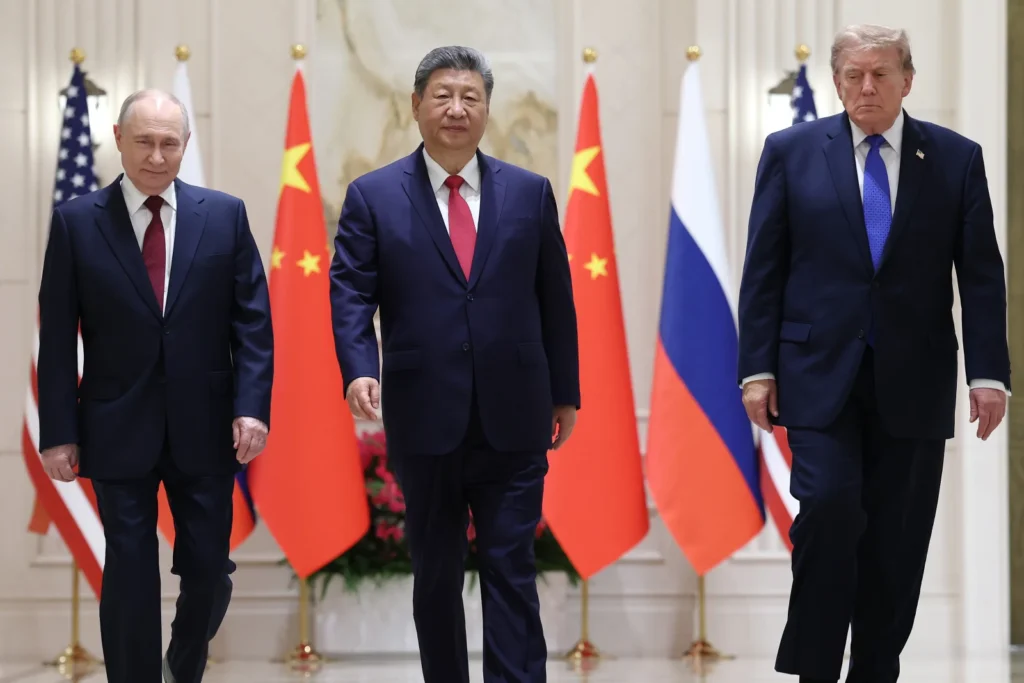







The leaders are set to meet Thursday in Shenzhen. Progress on nuclear risk, Ukraine or trade could give each something to take home. The harder test is whether their governments agree to act after the summit.
By Marcus Ellison | M•I•A MEDIA GROUP
SHENZHEN, China — President Donald Trump arrived in Shenzhen on Wednesday, where Chinese President Xi Jinping greeted him on the tarmac. Later, Russian President Vladimir Putin shook Trump’s hand before the Asia-Pacific Economic Cooperation summit’s welcome banquet. The three leaders are scheduled to sit down together Thursday. Trump also plans separate talks with Xi and Putin, giving him two opportunities to pursue issues that may be harder to resolve with all three men at the table.
Trump has said he wants to discuss limiting nuclear weapons and ending Russia’s war in Ukraine. The three-way meeting’s full agenda has yet to be released, and analysts quoted by The Associated Press expect limited progress. The separate U.S.-China meeting offers a venue for trade disputes, while Trump’s one-on-one with Putin would be their first talks since last year’s Alaska summit, which failed to produce an agreement on Ukraine.
What each leader wants from Shenzhen
Trump has several ways to claim progress. An agreement to start nuclear talks with China and Russia would give him a diplomatic achievement after New START, the last U.S.-Russia treaty limiting their strategic nuclear arsenals, expired in February. A concrete step toward a ceasefire process would give him something to show after Alaska. On trade, a commitment from Beijing with dates and terms could give American businesses more certainty about costs and supply chains.
Xi already has a diplomatic advantage as host. He can use the meeting to show that major security discussions can take place in China and that Washington is willing to engage Beijing directly. A more substantive gain would be a pause in trade escalation that makes it easier for Chinese exporters and their customers to plan. On nuclear weapons, Xi has less incentive to accept the sort of limits Washington and Moscow previously negotiated between themselves. Beijing has resisted earlier U.S. efforts to bring it into those talks.
Putin gains a chance to deal directly with Trump while reinforcing his relationship with Xi. He used his remarks in Shenzhen to criticize Western sanctions, and he and Xi held separate talks Wednesday. A meeting with Trump gives Putin a platform to press Moscow’s case. Whether he comes away with anything more will depend in part on his willingness to make commitments that Ukraine can evaluate and that other governments can verify.
What a win for all three would look like
The most plausible shared win would be modest enough to carry out. The three leaders could name officials to lead nuclear-risk talks, set a date for their first session and agree on an initial subject, such as how to communicate during a military crisis. Trump could point to a process that includes China. Xi could participate without immediately accepting limits designed for the U.S. and Russia. Putin could reopen a channel with Washington on an issue both countries have managed through negotiations for decades.
On Ukraine, a credible opening would be a commitment to bring Kyiv into the next round and explore steps that can be independently monitored. A prisoner exchange or an arrangement to protect civilian infrastructure could give negotiators a specific issue to work on. For Trump, Xi and Putin, the diplomatic value would come from starting a process that can survive the summit. For Ukrainians, its value would be measured in what happens on the ground.
What a loss for all three would look like
The worst outcome would be a summit that makes the disputes harder to resolve. A vague promise on arms control could leave each capital with a different understanding of what was agreed. A proposal for Ukraine drawn up without Kyiv could deepen distrust and make formal negotiations harder to start. A fresh round of tariff threats could leave businesses facing the same uncertainty the summit offered a chance to reduce. Trump would have little progress to point to, Xi’s effort to project stability would suffer and Putin would leave with renewed attention but no durable agreement.
By the end of Thursday, the clearest signs of progress will be concrete. Who is responsible for the next round? When will it take place? Will Ukraine have a seat in talks about its future? The handshake has already happened. The answers to those questions will show what the leaders did with it.