






By Camille Brooks | M•I•A MEDIA GROUP
In 1892, just 8,615 of Mississippi’s roughly 150,000 eligible Black men successfully registered to vote under the state’s new constitution. More than a century later, Mississippi still has the highest share of Black residents of any state, about 37%, and white conservatives have held most of its statewide power for generations. Democrat Scott Colom’s victory over Republican Sen. Cindy Hyde-Smith in November offers a chance to examine how that divide took hold and why it lasted so long.
Mississippi rewrote the rules of political power
During Reconstruction, Black Mississippians served in the state Legislature, and lawmakers sent two Black men to the U.S. Senate. Hiram Revels took office in 1870, becoming the first Black member of Congress. Blanche K. Bruce began a full Senate term in 1875. That same year, white Democrats used intimidation and fraud to regain control of Mississippi’s state government. Within a generation, they had written voting restrictions into the state constitution.
At the 1890 constitutional convention in Jackson, all but one delegate was white. The resulting constitution imposed a poll tax and gave local registrars broad discretion to decide whether prospective voters could read or interpret a passage of the state constitution. The restrictions also excluded many poor white voters. For Black Mississippians, the registration figures showed the scale of the exclusion. A community large enough to shape statewide elections was largely shut out of them.
The electorate changed, and so did the parties
Black Mississippians spent decades fighting to reclaim access to the ballot. In 1964, Fannie Lou Hamer, a sharecropper and organizer from Ruleville, helped lead the Mississippi Freedom Democratic Party’s challenge to the state’s all-white delegation at the Democratic National Convention. The following year, the federal Voting Rights Act suspended discriminatory voting requirements. That opened elections to many people whose families had been excluded for generations.
The party holding power also changed. Mississippi had been a one-party state under white Democrats for nearly a century. Starting in the 1960s, Republicans gained ground as the state’s Democratic Party fractured and voting increasingly split along racial lines. Ahead of the 2026 election, The Associated Press reported that Black voters typically made up about a third of Mississippi’s November electorate and overwhelmingly backed Democrats. White voters typically favored Republicans by at least 4 to 1. That pattern gave Republicans a durable advantage in statewide races.
Some rules from the 1890 constitution survived well into this century. Until voters approved a change in 2020, candidates for governor and other statewide state offices needed both a statewide majority and victories in a majority of state House districts to win outright. Otherwise, the decision could go to the state House. The rule governed state offices, while U.S. Senate races followed a separate process. Its longevity shows how long a system designed in the Jim Crow era continued to shape the way Mississippi chose its leaders.
What Colom’s victory changes
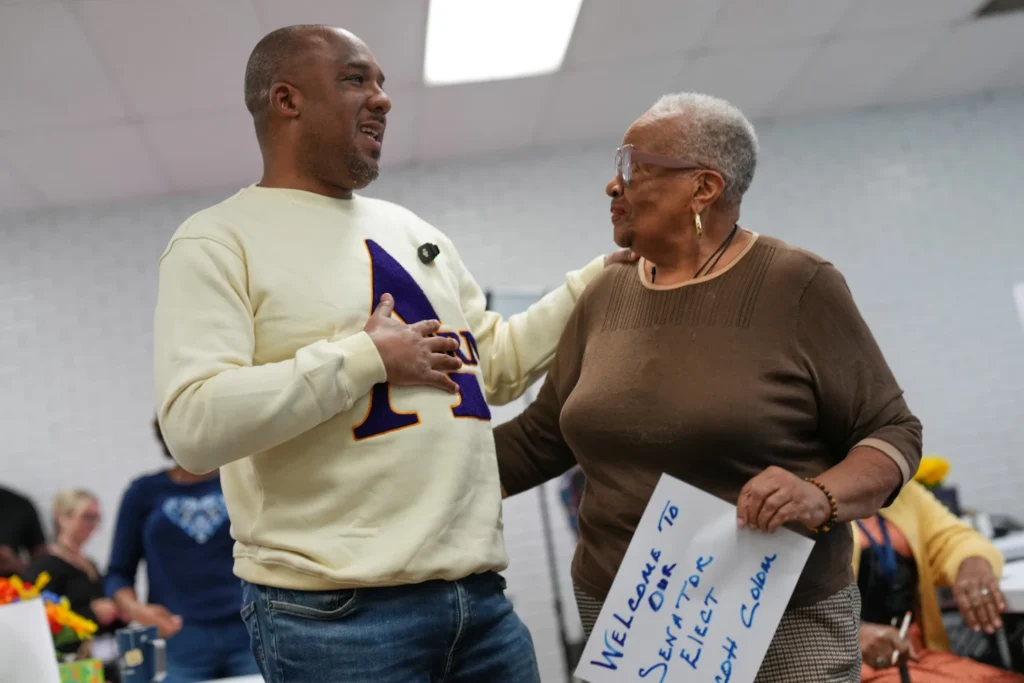
Colom will be Mississippi’s first Black U.S. senator since Bruce left office in 1881 and the first chosen directly by the state’s voters. Returns from the Mississippi Delta help explain how he got there. An Axios analysis of Associated Press county data found Colom ahead in 16 of the 18 counties in the Mississippi Delta National Heritage Area. Democrat Mike Espy had carried 15 of those counties in 2020. Colom widened the Democratic margin there, helping him win a statewide race decided by roughly half a percentage point.
Mississippi’s 2027 elections for governor and other state offices will test whether that coalition can win again. The Senate race already showed what can happen when a candidate builds on support in communities that have organized and voted for generations. In Sunflower County, where Hamer fought for the right to register, voters helped choose a Black senator whose election depended on ballots from places like hers.
