


With Florida’s races for governor and U.S. Senate tightening, Black voter turnout could help determine the state’s political future.
By M•I•A MEDIA GROUP
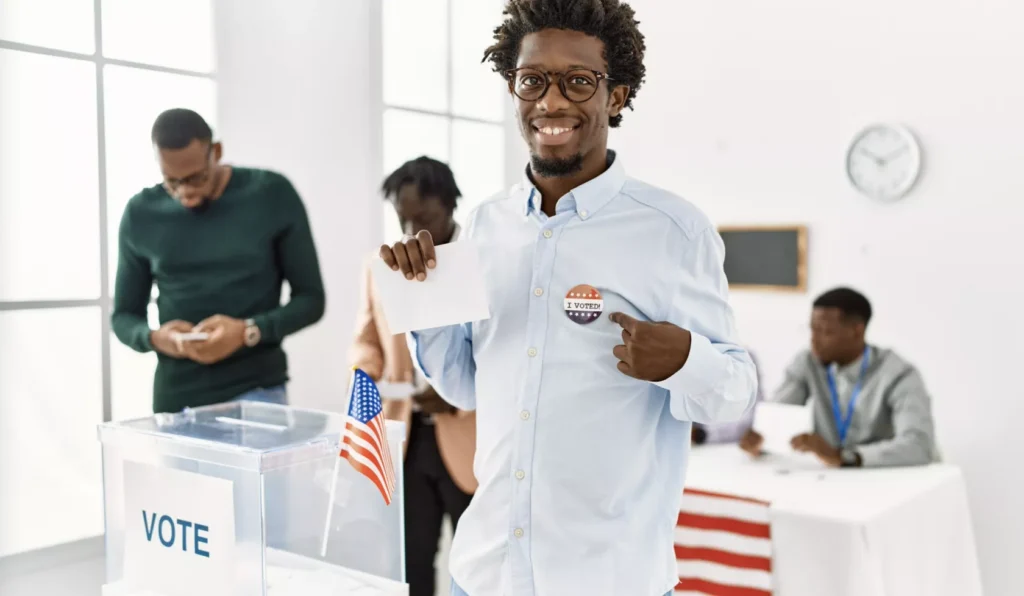
Florida’s political future could hinge on a constituency that has historically played a central role in shaping the state’s elections: Black voters.
With Election Day approaching Nov. 3, Democrat David Jolly is challenging Republican Byron Donalds for governor, while Democratic state Rep. Angie Nixon faces Republican U.S. Sen. Ashley Moody.
Both Democrats trail in recent statewide polling, but narrowing margins suggest that Black voter participation, particularly in South Florida, could influence the outcome of two consequential elections.
The stakes extend beyond party politics. Decisions involving public education, civil rights, housing affordability, health care and economic opportunity will affect Black communities for years.
Polls Show Competitive Races
A University of North Florida poll conducted Oct. 12-19 found Donalds leading Jolly 49% to 47%, a two-point advantage within the survey’s margin of error.
In the Senate race, Moody led Nixon 49% to 45%.
The survey of 1,471 likely voters carried a margin of error of plus or minus 2.81 percentage points. Both Republican candidates held larger advantages in July.
Other surveys show wider Republican leads, underscoring the challenges facing Democrats in a state where Republicans maintain a substantial voter registration advantage.
Nevertheless, the narrowing margins highlight the potential importance of turnout.
Jolly’s Challenge: Mobilizing Black Voters
The governor’s race presents an unusual political dynamic.
Donalds, a Black Republican congressman and close ally of President Donald Trump, is seeking to become Florida’s first Black governor.
Yet shared racial identity has not translated into overwhelming support among Black voters.
The University of North Florida poll found Donalds receiving approximately 10% support among Black respondents.
Jolly, a former Republican congressman running as a Democrat, has emphasized civil rights, public education and economic affordability.
For Jolly, strong Black voter participation could provide an important foundation for overcoming Donalds’ statewide advantage.
But support alone is insufficient. His campaign must also attract independents and moderate Republicans.
Nixon’s Opportunity in the Senate Race
Nixon faces a similar challenge against Moody, Florida’s former attorney general.
A Democratic state representative from Jacksonville, Nixon has emphasized working families, economic inequality and government accountability.
Her campaign offers voters a contrasting approach to Moody’s conservative positions on federal policy.
The University of North Florida survey found Nixon leading Moody among independent voters by 15 percentage points, while Jolly led Donalds among independents by 16 points.
Those findings suggest both Democrats have opportunities to build broader coalitions.
However, Nixon must overcome Moody’s fundraising, name recognition and Republican support.
South Florida’s Political Influence
Miami-Dade, Broward and Palm Beach counties could prove especially important.
Black communities in Miami Gardens, Overtown, Liberty City, Miramar, Lauderhill and West Palm Beach represent significant concentrations of voters.
Their concerns include affordable housing, rising insurance premiums, educational opportunity, small-business development and access to quality health care.
Black voters are not politically uniform. Their priorities differ across generations, income levels and communities.
But participation across these neighborhoods could influence statewide margins.
The Power of the Black Vote Could Change Florida’s Future
For David Jolly and Angie Nixon, the path to victory could run directly through Florida’s Black communities. But the significance of this election extends far beyond two candidates or political parties. At stake are the policies, opportunities and protections that will shape the lives of generations to come.
Black voters have the potential to influence the direction of Florida’s leadership at a defining moment in the state’s history. Their votes could determine whether Republicans maintain their political dominance or Democrats begin a new chapter in Florida politics.
The message is unmistakable: Black voters cannot afford to be overlooked, underestimated or taken for granted. In an election where every percentage point matters, their participation could mean the difference between victory and defeat.
On Nov. 3, Florida will decide who governs. And Black voters could help decide who holds the power, whose voices are heard and what kind of future awaits the next generation.
